

Sunil Kumar R (1985)
A diffusion cloud chamber is a simple yet elegant particle detector that makes the invisible paths of ionizing radiation visible to the naked eye. Unlike the original expansion (Wilson) cloud chamber, which requires periodic expansion of gas to create supersaturation, the diffusion type operates continuously, making it popular for educational demonstrations and hobbyist experiments.
How It Works
The device consists of a sealed chamber with a significant vertical temperature gradient:
– The top is warm, where a volatile liquid like isopropyl alcohol or ethanol evaporates, filling the chamber with vapour.
– The bottom is kept very cold (typically below -26°C / -15°F) using dry ice or a Peltier cooler.
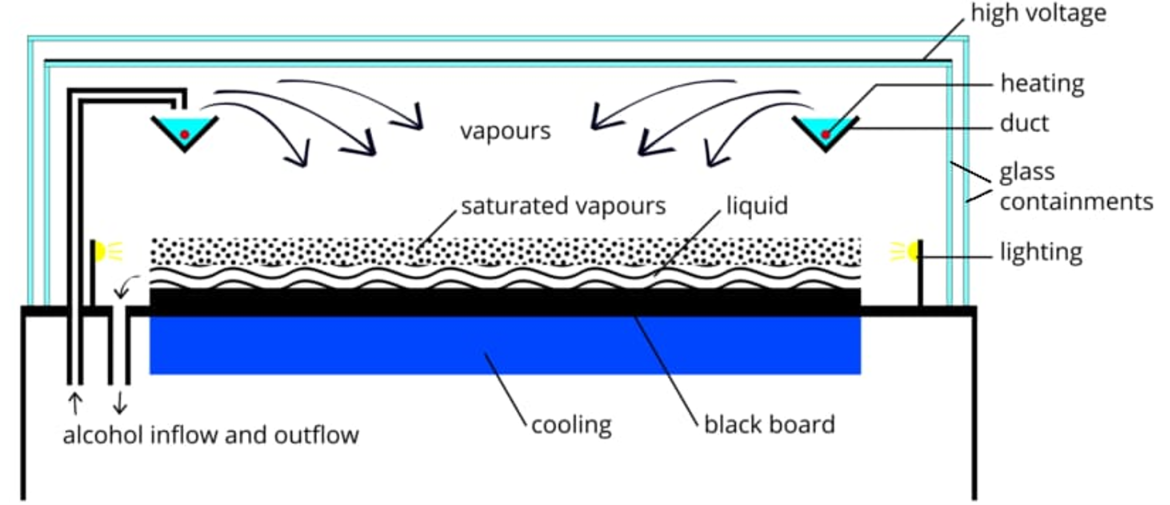
As the alcohol vapour diffuses downwards and cools, it creates a layer of supersaturated vapour just above the cold base. When a charged particle (such as an alpha particle, beta particle, or cosmic ray muon) passes through this sensitive region, it ionizes the gas molecules along its path. The alcohol vapour condenses around these ions, forming visible misty trails or “clouds” that trace the particle’s trajectory.
Different particles produce distinct tracks:
– Alpha particles: Thick, straight, short tracks (high ionization density).
– Beta particles: Thinner, longer, and often curved tracks.
– Cosmic rays/muons: Long, straight tracks.
History
The original cloud chamber was invented by Scottish physicist Charles Thomson Rees Wilson around 1911 (Nobel Prize 1927). The diffusion cloud chamber was developed later in 1936 by Alexander Langsdorf, offering the advantage of continuous sensitivity without mechanical expansion.
Significance
Cloud chambers have played a crucial role in early particle physics, helping visualise subatomic particles and contributing to discoveries like the positron. Today, they remain one of the most accessible ways for students and enthusiasts to observe radiation and understand fundamental physics phenomena. Simple versions can even be built at home with common materials like a glass jar, dry ice, and rubbing alcohol.
Here is a short video of the Diffusion Cloud Chamber designed and built by MI Technologies, Bangalore.