

Chandra Shekhar (1985)
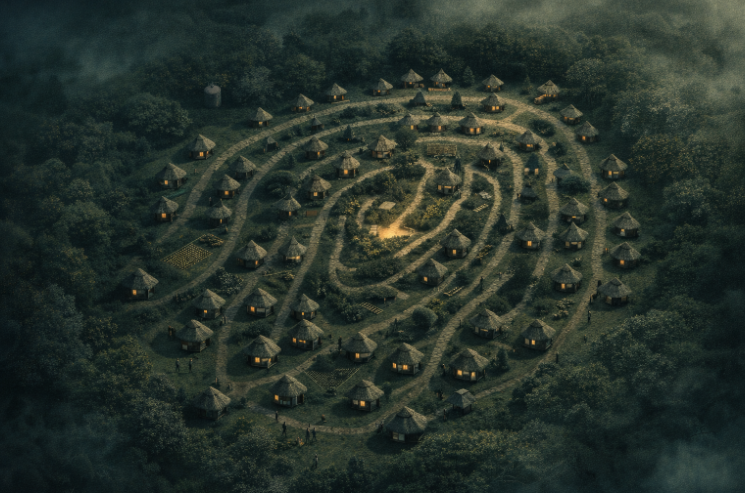
Illustration: AI Generated
Ten years ago, I wrecked Don’s literary career.
Now I had come halfway across the world to apologize to the man whose life I had ruined. When I knocked on his door, I feared he would greet me with a shotgun blast.
As it turned out, he had something far more explosive in store for me.
Don had started writing a few years before my act of literary demolition. His first book, Chi Squared, was a respectable failure, while the second and third fared only slightly better. Critics were ready to write him off. His friends and family urged him to stick to his day job of teaching English to university freshmen.
With his fourth novel, however, he began to score. “Disguised as a pulse-pounding thriller, Mean, Mode, and Median presents a bleak yet ultimately optimistic view of human nature,” I wrote in my Guardian review. Cross Correlation, his next book, did even better with both critics and the reading public. Here again, the masterfully rendered thriller elements served only to sugarcoat a searing condemnation of human behavior that somehow ended on a positive note. After this, to increasing acclaim, came Uniform Distribution, Stochastic Process, Standard Deviation, and then the work most critics consider his best, Random Numbers.
A cottage industry of academics sprang up to explain what the enigmatic statistics-themed titles meant. According to one authority, Uniform Distribution referred to activities at the army depot where the novel was set, while Standard Deviation pertained to the eccentricities of its protagonist. Another found religious implications in Cross Correlation. I believed Don had chosen the first title on a whim and then retained the statistical conceit simply for the sake of consistency.
Beneath their fast-paced cloak-and-dagger motifs, each of these novels portrayed some ugly aspect of the human condition and ended on the characteristic life-is-vile-yet-beautiful note of unexpected, wonderful uplift. Each time I read one of his books, I felt increasingly bereft of hope until I reached the last act and then, miraculously, began to feel good again—and kept feeling better and better—until I, like millions of others, finished the novel laughing and crying with joy.
And then he wrote Strands of DNA.
My fellow critic at The New York Times blamed the non-statistical title. A Stanford professor attributed the outcome to the unusual length of the work—more than a thousand pages. Someone else commented on the excessive use of single-line paragraphs.
Whatever the cause, the outcome was beyond dispute. To say that the novel failed would be the understatement of the literary world. Don’s previous books were notable for their simple prose and clarity of expression. Literary they were, but none were difficult reading—and the public loved them. But Strands of DNA? The book baffled me. What did all those rambling thoughts and disjointed phrases mean? Where were the realer-than-life characters, the impossibly witty yet convincing dialogue, the tragicomic situations, the signature linguistic flourishes, the verbal images so graphic and evocative they seemed to burn themselves into your brain? Where was the sense, the logic?
The book was pure gibberish.
I suspected some kind of hoax, but a call to the publisher convinced me otherwise. Then I blamed myself. Wasn’t I the one in my undergraduate literature class who saw no merit in To the Lighthouse, thought The Sound and the Fury overrated, and gave up Ulysses after fifty pages? And to this day, was I not the only literary critic who still didn’t “get” these modernist masterpieces? Suddenly, I felt like a fraud. I wondered whether I should quit my profession and do something more suited to my talents, such as writing B-movie scripts or promotional copy.
Fortunately, before I could resign from the Guardian—and send the letter to my editor that I had long fantasized about, in which I would tell her exactly what I thought of her editing style, grammar, vocabulary, and overall taste—I began to hear from other critics through the grapevine. They seemed equally bewildered. They didn’t openly say so, but used cautious euphemisms—interesting, intriguing, atypical, unexpected, certain to puzzle readers—that, to an insider, signified bafflement. They seemed to be waiting for someone bold enough to step forward and trash the book. Eventually someone did, and then the rest of us followed. And trash it we did.
Had the book been the work of a less gifted writer, we might have reacted more mildly. With his brilliant Random Numbers, however, Don had lofted our expectations into the stratosphere, and our disappointment with Strands of DNA was proportionately severe. But while my fellow critics couched their disdain in polite language, I showed no such restraint.
I tore the book to shreds. All my life I had smarted from my failure to appreciate Woolf and Faulkner and Joyce and their ilk. Now I seized this opportunity to pay the literary world back. My essay in the Guardian was not only the most blistering review of Strands of DNA but one of the most scathing literary essays of all time. I attacked Don for eschewing linear narratives and old-fashioned storytelling in favor of what I termed “literary gimmickry.” I poured into my review all the scorn I felt for works that everyone praised but I didn’t understand, and I didn’t hesitate to express my contempt for the academics who admired obscure works from some arcane “literary” perspective.
My review of Strands of DNA established my reputation as the alpha critic of the literary world. My editor had been on leave when I wrote the piece, which allowed me to publish it unedited. My first use of my newfound fame was to get her replaced with a puppet who would never dare touch my essays. Armed with this carte blanche, I attacked modernism of every sort. And in doing so, I went beyond the merely literary: I condemned abstract art in all its forms, whether on the page, canvas, pedestal, or stage. I never knew I had that much spleen in me.
Then I tried my hand at fiction. Though I didn’t write well, my novels had a modest following thanks to my reputation as a critic.
Don had no such luck. After my review appeared, his stock plummeted. It seemed certain that no major publisher would ever touch his work again. In any case, he never published another book and soon dropped out of sight.
Today, few read his work, and even Random Numbers has gone out of print.
Ten years after engineering Don’s literary eclipse, I stood at his doorstep, pulse pounding and palms sweating. Why was I there? Yes, I felt guilty and ashamed for my nasty review and its devastating aftermath. I wanted to make amends. But I had a more selfish reason too.
In penning my critique of Strands of DNA, I had expressed not only my disappointment with the book but vented all the bitterness of a lifetime of literary exclusion, born of my inability to understand any form of art that appeared modernist, abstract, or experimental. Having published my review, I’d felt vindicated and triumphant. The experience had been both cathartic and rejuvenating. My euphoria had lasted for months.
But over the years, doubts crept in. Though my essays still sizzled, my venom increasingly felt like a pose. In the first flush of triumph after my Strands of DNA review, I thought I had put the ghosts of my self-doubt and literary diffidence to rest. But even as I blossomed as a critic, I grew less sure of myself. I began to suspect that I was missing out on something vital in art. Perhaps the deeper realities demanded more oblique forms of expression. Perhaps the modernists had been right all along. Had I confused their lack of accessibility with a lack of merit?
Meanwhile, my life had been falling apart. My second and then my third marriages failed; my only daughter cut herself off from me. On the printed page I sounded as confident and arrogant as ever, but to myself my words rang increasingly hollow. I wondered whether there was much about life and art that I had never understood. One evening, when my spirits were at their lowest, I dusted off a copy of Strands of DNA from my attic and began to read it again. It was heavy going, but I persisted. And as I read on, it seemed to confirm my worst fears about myself. Not that the novel suddenly made sense—it didn’t—but I got the impression there was some method behind the madness, some hidden meaning all the more profound for being obscure.
I felt that my best hope of finding out what it all meant—Strands of DNA, modernism, abstract art, any art, even life itself—was to go to the source, to Don himself. That was how I found myself one summer afternoon in a commune in the foothills of the Western Ghats, two hundred miles north of the Indian city of Mangalore, face-to-face with the ex-writer whose career I had destroyed.
I knocked on the door of Don’s hut, one of several hundred identical thatched dwellings in the commune. After waiting a few seconds, I knocked harder. The house seemed empty. I pushed the door open and walked in. The room was dark, but at the far end an open doorway led to a patio where the shade of a mango tree and a breeze from the mountains softened the midday heat. Dead tired and jet-lagged after my journey from the opposite side of the planet, I collapsed into a cushioned cane armchair and fell into a fitful doze.
It must have been about half an hour later that I woke to hear an almost-forgotten yet still familiar voice.
“Dave!”
In the doorway, eyebrows raised, stood the man I had come to see. He looked different from the nondescript figure I remembered: leaner, darker, his hair more unkempt, his gaze more direct. In his stance there was something noble, impressive—almost a touch menacing. The phrases I had rehearsed for this moment deserted me. What could I say? Sorry for ruining your life… I promise not to do it again? I remained speechless, my gut clenching, the drumming in my chest almost audible.
Don recovered first. To my relief, he showed neither fury nor hatred, but offered me iced lemonade and asked about my trip. As I worked up the nerve to make my long-overdue apology, he gave me an opening.
“So what brings you here?”
“You’ve probably guessed the reason.”
“No clue… though I’m delighted to see you.”
“Don, I should’ve done this years ago, but better late than never. I came to say I’m sorry.”
He stared at me. “Sorry? For what?”
“For writing that ugly review of Strands of DNA. I can’t tell you how much I regret it.”
His eyes widened. “What on earth are you talking about? What ugly review?”
“The one I wrote in the Guardian. Don’t you remember it?”
“No, I never read reviews. What did you say in it?”
I gulped a couple of times. This was my chance to escape with a mild self-denunciation, citing just a few of the least vicious lines from my review. Don would then tell me it was no big deal, and my apology would be complete. Painless.
But I hadn’t come this far to lie.
“I said every nasty thing that came to mind. I didn’t understand your book, but instead of admitting it, I attacked you. While other critics showed restraint, I let myself go like a firebrand preacher denouncing immorality. It was unforgivable.”
He smiled indulgently. “Don’t be so hard on yourself. From what you say, it seems you weren’t the only one who panned my book. After all, you’re a critic, and that’s what critics do, right? Criticize?”
“Yeah, but I was way out of line. And I feel terrible about what effect it might have had on your career. One critic can only do so much damage, but I blamed myself when the years went by and you never wrote another book.”
To my astonishment, he burst out laughing. “My dear fellow, Strands was meant to be my last book. I had no intention of writing another.”
“Really?” I almost pleaded, wanting to believe him, yet unable to. Perhaps he was just trying to spare my feelings.
“Yes, really. You’ve been worrying about nothing. Not to downplay your impact as a critic, but your review had no effect on my career. I simply decided to quit. That’s all.”
“Really?” I said again, a tentative smile of hope and relief trembling on my lips.
“I swear. I stopped writing for entirely different reasons.”
“Oh, geez, I can’t tell you what a weight off my shoulders this is. All these years I’ve felt like a louse, and now you’re telling me nothing I said mattered?”
Don struck his forehead with his palm in good-natured scorn. “Oh, you critics! Always overrating your importance. Forget your review. Finish your drink, and I’ll show you around.”
With a new bounce in my step, I accompanied my host on a tour of his commune. As a journalist, I’d visited other self-contained communities, and at first glance this one seemed no different. The residents appeared to come from a variety of races and nationalities. I guessed their average age to be about fifty, though I did see a few children and one gray-haired woman who leaned on a stick. Everyone wore loose, informal, practical clothing. They waved to us cordially but went on with their activities—gardening, cooking, washing, mending, chatting, playing. The ambiance was one of noisy camaraderie overlaid with meditative calm.
As we continued the tour, my psychic antenna began to pick up some interesting signals. I noticed that though no one seemed to be in charge, everyone appeared to know what to do. And though their generally cordial interactions were occasionally punctuated by raised voices and even shaken fists, these conflicts fizzled out quickly, like ripples in a pond. I also noticed the absence of politeness: people expressed themselves freely and frankly, even rudely, yet nobody seemed to take offense. It was as if a deeper harmony made it safe for the residents to vent their feelings without restraint.
We returned to Don’s patio and drank more lemonade. I tried one of my host’s handmade cheroots and enjoyed it, though its smoke scorched my delicate American mouth. I leaned back in my chair and put my feet up on a wooden footstool.
After a few minutes of companionable silence, I cleared my throat. “Don.”
“Yes?”
“I came here to say I’m sorry, and even though you said I didn’t need to, I’m still glad I did.”
“I’m happy you got that off your chest.”
“But that’s not the only reason I came.”
“Yeah, I figured there was something more.” He chuckled. “You want to know what I’m up to here, right?”
“In a way, yes. I wanted to know why you wrote Strands, and what it’s supposed to mean. I guess if I understood that, I’d know what you’re doing now—and perhaps a lot of other things as well.”
“Sure, but why the sudden interest? It’s been ten years since Strands came out, and I’m surprised you still remember it.”
“True, but I haven’t come here wearing my literary hat.”
“No?”
“No. The fact is… I used to think I knew all the answers, but over the years I’ve lost faith in my own judgment. And for some reason my thoughts keep circling back to your last book. Something tells me it might unlock some psychic door for me. You know—make me more self-aware, if only I understood it.”
“Hm.” Don shook his head gently. “You shouldn’t expect to learn too much from one book or one person. But you’ve come all this way, and I don’t want to send you away empty-handed. Ask me anything you want.”
“That’s very kind.”
“No worries. It’s ages since I’ve enjoyed a chat with someone from outside the commune.”
“You haven’t told the story behind Strands to anyone else?”
“Never. Other than the folks here, everyone hated the book. Why would they want to know more about it?”
“But the readers who did like the book and joined you here?”
“They didn’t need to hear the story behind it, because they already understood it.”
I stared at him. “But how could they understand it if you didn’t explain it to them?”
He took a thoughtful sip from his glass and gazed at me for several seconds with a faraway look. “That was the whole point.”
I waited for him to continue, trying not to hold my breath. But his next words only deepened my confusion.
“Dave, have you ever wondered about your tribe?”
“My what?”
“Your tribe.” He stressed the last consonant so much that the word came out traibbbbbh.
“I’m sorry, but what tribe are you referring to?”
“Have you ever wondered if there were others like you? People who see the world with the same eyes? People who react to things the same way?”
I re-lit my cheroot and took a deep puff to clear my head.
My host waited politely for my coughing fit to subside, then asked, “Do you get what I’m talking about?”
“I’m not sure. Are you asking whether I’ve wondered if there were others with a similar worldview?”
“Yes—but more than just worldview. Similar to you in every deep sense.”
“Hm. You mean people who feel the same way I do? My tribe in an abstract sense?”
“Exactly. People to whom you’d never need to explain yourself. People with whom you’d have an understanding so deep it would amount to telepathy. Have you ever wondered if they existed?”
I thought for a few moments. “I suppose so. Like most people, I’ve wanted to find at least one person with whom I could enjoy that kind of deep connection.”
“And if such people existed, wouldn’t you want to find them?”
“Who wouldn’t? But how would one do that?”
“That’s where Strands comes in.”
I dropped my cheroot on the ground and gripped the arms of my chair so hard they creaked. “How so?”
Don looked at me for a moment, then broke into a mocking yet kindly smile. “Like most people, I longed to find kindred souls. It became an obsession. After a while, nothing else mattered. I had to know if my tribe existed. I mean, I knew it existed—but I didn’t know how to find it.”
He had been gazing into the distance as he spoke, but now he paused and glanced at me to see if I was following.
“How did you find it?” I asked, leaning forward.
But my host was not to be hurried. He continued in the same dreamy, deliberate tone. “You may wonder how I knew my tribe existed. If I claimed some special intuition, I know how skeptical you’d be.” He seemed to brace for a scornful reaction, but after years of professional ennui and personal failure, my cynical, rational self had worn thin. I was ready to believe almost anything. If he had claimed inspiration from a godlike alien from Jupiter with two heads and five eyes, I wouldn’t have laughed. Even so, his next words caught me off guard. “No—what guided me wasn’t intuition or instinct, but statistics.”
“Statistics?”
For the second or third time that day, I felt a moment of mental paralysis, as if I’d woken in darkness in a strange room. Then a light broke over me—not a bright one, but a dim, flickering glow that strengthened as the silence stretched between us. A partial realization dawned.
“Is that why you used all those statistical book titles?” My voice squeaked with excitement.
“Yes, but not consciously. Those titles seemed to make sense at the time, and only later, as I was writing my last book, did I understand why I’d chosen them. By then I knew what I was doing. I no longer needed the statistical theme, which is why Strands doesn’t have it.”
“Yes, but where do statistics come in?”
“Of the five hundred or so people I knew then, about a dozen were somewhat like me. And I don’t mean in appearance or other surface traits, but in how they perceived and reacted to the world. Of those dozen somewhat kindred souls, one was significantly more like me than the others. Yet even he was different enough that I couldn’t truly relate to him.”
I struggled to make sense of this. “You mean, he was the closest to you—yet not close enough?”
“Exactly. That’s where statistics came in. I knew most people were very unlike me. But the world has about eight billion adult humans, and among them there must be enormous variation. Some would be rather like me. And a very special handful would be so similar to me that they’d be my spiritual twins. I took a wild guess that there should be around a thousand such people—my tribals, so to speak. And a thousand is roughly what I ended up with.”
“But damn it, it can’t be that simple, or else we’d all have found our tribes by now!”
“I’m not saying it’s simple. The problem is this: of the billions of people on the planet, how many can we actually know? Given infinite time and opportunity, we could meet every one of them and figure out who belongs in our tribe. But in reality, we get to know at most a few hundred.”
“True.”
“In statistical terms, we are sampling the space of possible relationships extremely sparsely.”
“I was never strong in stats, Don. What does that mean?”
“An analogy might help. Imagine trying to grasp the shape of the Himalayas on a dark night using only a few laser pointers.”
“Is that what you mean by sparse sampling?”
“Exactly. And continuing the analogy, what if you could light up the entire Himalayas?”
“But how?”
“We can’t.” He shook his head. “It would take too much electricity. All the power plants in the world combined wouldn’t provide enough wattage.”
I nodded, chuckling. “Not to mention the mountain-sized bill they’d send you.”
“Right. But what if you could make the Himalayas light themselves up? Or at least make those thousand or so points on them that matter most to you light themselves up?”
I stared at him again—not, this time, in perplexity, but with a sudden comprehension that left me speechless.
Don waited patiently. The silence stretched. Sounds of laughter, singing, and distant mechanical noises drifted in, softened by distance, but on the patio a deep hush settled with the moist evening air.
“You… you found a way to make your tribe come to you? Instead of looking for them, you got them to look for you?”
“Yes.”
“That’s why you wrote Strands?”
“Yes. Strands was like a coded treasure map. The treasure was our tribal identity, which only those who understood the code would discover.”
I sat there, stunned. My rational self—whatever pathetic husk of it remained—tried to reject everything I’d heard. It was nonsensical, just like Don’s book. But my limbic, emotional, intuitive self knew this was no ordinary nonsense—it was magnificent, sublime nonsense that outshone even the most glittering logic. It was the truth: realer than real, though utterly unreal.
“You mean that’s why I failed to get what you were saying in Strands?”
“Yes. Dave, you’re a great guy, but”—he made an exaggerated frown to soften the blow—“you’re not a kindred spirit to me. You don’t belong to my tribe. That’s why you didn’t get the book.”
My rational self still refused to surrender. “But that’s crazy, man! Are you saying the ones who do belong to your tribe got it?”
“Well, I can’t vouch for every single one. Not all would have been able to get the book and read it. Many might not even have heard of it. Some might be illiterate. Non-English speakers would lose something in translation. But of those who read it, I think most got it.”
I tried to wrap my head around this. “And… and then they came to you?”
“The moment they read it, they knew they’d found what they’d been looking for all their lives, even if they hadn’t realized it before. They were home.”
“But how did they end up here? How did they know what to do? Don’t tell me this commune just sprang up by itself!”
“Oh, getting them here and setting this place up was just logistics. We had to raise money to buy the land—not much, given how large and lovely it is. And as it turns out, some of my tribe members were wealthy. Along with their money, my tribals brought their skills and talents. Building the settlement, setting up the farms, all the everyday logistics—I could leave that to abler hands.”
I shook my head. “Just like that, your tribals pulled up stakes and came here? Leaving all their careers and friends and associations behind?”
“Yes. Most even left their families behind, with no intention of seeing them again.”
“Jesus! You’re telling me this tribal instinct is stronger than family ties?”
“Far stronger.” Don smiled at my wide-eyed disbelief. “Astonishing, isn’t it? But think of it this way. Imagine being stranded on a strange planet among loving but alien creatures. If you got a chance to return to Earth, wouldn’t you drop everything and rush back?”
I reflected for a moment. “Yeah, but that’s apples and oranges. I’d be returning to an environment I knew, whereas most of your tribals went somewhere they’d never been before. Didn’t they have a hard time adjusting? I mean, here you’ve thrown together a thousand strangers from a hundred different cultures and asked them to build a community. It must have been—like—pure chaos!”
Don chuckled. “Not really. It did take us a while to get properly settled, but it was never chaotic. True, there were a thousand of us here, and we’d never set eyes on one another before. We spoke different languages, ate different foods, knew different climates. Some were young, some middle-aged, some old. Some were rich, some less so, and some had been living hand to mouth. Some had written textbooks, while others hadn’t even finished high school. We were incredibly diverse. But we weren’t strangers at all.”
“Despite all your differences?”
“Our differences were stark, but only on the surface. We shared a spiritual connection so deep and rich that we could relate to one another instantly.”
I shook my head. “I still can’t believe it.”
“Dave, things like this happen all the time in nature, and we don’t even stop to think about them. Consider a snowflake—it’s an amazingly intricate structure made of trillions of identical water molecules. Who tells those molecules where to go so that the lovely crystalline shape emerges?”
I shook my head. I’d never thought of snow as anything but a nuisance to be shoveled off my driveway. My daughter had learned in school that no two snowflakes are identical, but since this fact didn’t help with the shoveling, it didn’t interest me.
He went on. “The answer is: nobody tells the water molecules where to go. They self-organize. And the same process happens in a million different ways, in a million different contexts, from galaxies to the structures in your body. So why can’t a tribe like mine form itself?”
I lit another cheroot. My mouth felt as if it had been seared with hot coals, but my attention stayed fixed on my host’s words. It was all clear, yet incredible. Incredible, yet clear. Incredibly clear. Still, my rational self refused to quit.
“I can see how such a personal tribe could emerge,” I said. “But how did you manage to write a book that only its members would understand?”
“It wasn’t that hard, really. But… you already think I’m crazy, don’t you? If I explained what I did, you’d think I was even crazier.”
“I feel like I’m the crazy one here. And I’m dying to know what you did.”
“Well, for several years I made it a habit to write down any sentence or turn of phrase that seemed profound to me, even if it had no bearing on anything else. I ended up with thousands of pages like that.”
“Really?”
“Yes. And as you might remember, I used to teach writing in the old days. At the start of every class, I’d hand out a page or two of my random jottings and ask my students to highlight the sentences that made the least sense to them. I don’t know what they thought of this exercise, but they did it willingly enough and even seemed to get a kick out of it. At the end of each lecture, I gathered the papers and noted the sentences that almost everyone had highlighted. Over the years, I accumulated enough meaningless sentences to fill a book.”
I gaped at him. “No, no—please don’t tell me Strands was just a jumble of random sentences!”
He laughed. “Seemingly random. Yes, the novel was essentially nothing more than a collection of those sentences I found meaningful and most others didn’t.”
“Wow.” I struggled to collect my thoughts. “So anybody could do what you did? If I jotted down my random ideas and kept only the ones most people rejected, I’d have my own Strands? And then I could just publish it and wait for my tribe to show up at my doorstep?”
“Absolutely. If more and more people did this, at some point their tribes might even start to overlap. I haven’t thought that far. But in principle, I don’t see why you—or anyone else—couldn’t do what I did.”
“Wow,” I said again. “This is the craziest thing I’ve ever heard, but I’m sold. I’ll start today. Maybe a few years from now I’ll be leading my own tribe!”
Don roared with laughter, and I joined in. Then his expression turned serious. “You don’t have to wait years for that to happen, Dave.”
“But it took you that long, didn’t it?”
“Yes, but my technique was crude. Since then, I’ve found a much faster way—one that involves random words rather than sentences. You could do in a few weeks what took me half a lifetime.”
I waited, pulse pounding and gut clenched, but Don seemed to withdraw into himself. After a minute, I broke the silence, trying to sound casual. “So what is this new tribe-gathering technique of yours?”
“I’m not sure I should tell you.”
“But why? You’ve told me so much already. You can’t leave me hanging like that.”
“This new technique is different.”
“In what way?”
“It’s powerful. Far more so than the method I used in Strands. By telling you, I’d be putting a lot of power in your hands. I’m not sure you’re ready.”
I stared at him in dismay. “Don, I swear to you I’ll never misuse your technique. I’ll use it purely as you have—to find my soulmates and create my spiritual home. And for nothing else.”
He shook his head, but I persisted. “Please tell me, Don, please. I’ll never misuse it. I promise, by all I hold sacred.”
So, after much coaxing, he finally told me his secret—which I will now share with the world. Instead of repeating what he said, however, I’ll tell it in my own words:
Tribe blue temporary notice evident tribe. Belong at at belong belong red green red dripping wet! Pulsating laughter acrid nonchalant box corrosive confused light from copper assemble ballistic pastoral blob; jagged cradle noise haunting fluid bullet (hangover flamboyant contest eagle blame body soul soul dismissal guru) glossy in in in in in cottage ammonia together augmentation wisdom? Appetite behead knuckles captured cry! Bliss hirsute find barge rage innate melt crook aerial camel meaning harmless love gaze favor tribe put put put …