

Latha K Chirayil (1996)
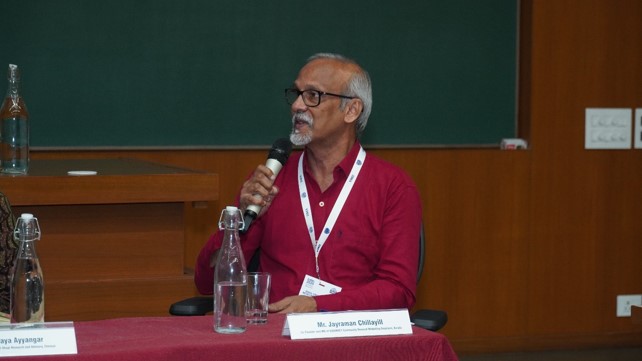
Co-founder and Managing Director of EQUINOCT, two-time Fulbright Fellow at Lawrence Berkeley National Laboratory and author of award-winning book Oorjaayanam, Dr. Jayaraman Chillayil has carved a niche for himself in the public life of Kerala, as a writer and a crusader for causes of contemporary relevance like energy conservation, climate change mitigation, flood prevention and advance warning, just to name a few.
EQUINOCT (“Enhancing the Quality of life through Innovation and Networking”) is an organisation focusing on implementation of advance warning systems for sudden floods and other preventive/mitigative measures to reduce damages due to natural calamities, all with the engagement of local communities and individuals, and working closely with the district administration. EQUINOCT was the only Indian startup selected for UNICEF’s Climate Tech Cohort in 2024.
Starting from CREC (1985 batch, Electrical) Dr. Jayaraman’s journey has been quite adventurous to say the least. Recently I had the opportunity to have a conversation with him for the RECAA Club Kochi Newsletter, of which I am an editorial board member. This discussion explored Dr. Jayaraman’s extensive 40-year career across industry, academia, community-centric climate solutions, sustainable living and social responsibility. A few excerpts are shared below.
Your PhD thesis is focussed on the behavioural dimensions of energy efficiency in SMEs. Why do many technical energy audit recommendations fail to be implemented and how to bridge this gap?
My primary area of focus has always been energy. I am a certified energy auditor, and in many ways, my professional journey took a decisive turn when I was deputed as the State Coordinator of the Petroleum Conservation Research Association (PCRA) while working at the BPCL Kochi Refinery.
I often feel that until I joined PCRA, I was merely an electrical engineer. But my years there transformed me into an engineer in a far more holistic sense. The work demanded an understanding not only of electrical systems, but also of mechanical engineering, chemical engineering, transport systems, industrial processes, and even behavioural practices related to energy use. PCRA’s mission was to create awareness across industries, transport, agriculture, and households about fuel conservation and energy efficiency.
At that time, energy auditing was still relatively unfamiliar in India. PCRA used to conduct free energy audits, promote efficient driving practices, create awareness about energy-saving cooking methods, and support energy conservation in agriculture and industry. Those years fundamentally changed my understanding of energy and sustainability.
I was essentially a one-man army in Kerala. I travelled extensively across Kerala and outside, interacting with industries, institutions, and communities, trying to understand energy not merely as a technical issue but as something deeply connected to systems, behaviour and society.
After completing my tenure with PCRA in 2003, I returned to the refinery. Around that time, the Bureau of Energy Efficiency (BEE) introduced a national certification examination for Energy Auditors and Energy Managers. Seven of us who cleared the very first examination decided to form a professional network of certified energy professionals. That was how Society of Energy Engineers and Managers (SEEM) was born.
We started with just seven members, but today SEEM has grown into a network of more than a thousand certified energy auditors and managers across India. We also launched a professional publication called Energy Efficiency Manager, which became quite well known in the field.
It was during this phase that I began reflecting deeply on a troubling question. Even though industries regularly conducted energy audits and received technically sound recommendations, a large number of those recommendations were never implemented. In many cases, the reports were not even read.
This unresolved question eventually became central to my PhD research. Initially, many academics were dismissive. Even my PhD guide and others would sometimes say that I was doing “consultancy work,” not research. Their view was that research had to be abstract and theoretical, while I was trying to solve practical problems. But I continued because I felt the issue was fundamentally important.
During this period, I received a Fulbright Program fellowship – Fulbright Kalam Climate Change Fellowship – and went to the Lawrence Berkeley National Laboratory, one of the world’s leading energy research laboratories, home to numerous Nobel laureates and major global energy studies.
I believed that being in the United States would help me understand how industrial energy auditing functioned in a more mature ecosystem. The US had an extraordinary documentation system for industrial energy audits, particularly for small and medium industries. Through the Industrial Assessment Center programme, they maintained records dating back to 1982, detailing how many audits were conducted, what recommendations were given, the expected savings, and how much was eventually implemented.
However, one critical piece of information was missing: why recommendations were not implemented. Those details were considered confidential and were not publicly released. And what I discovered was striking: the main barrier was not technology, economics, or feasibility. It was behaviour.
My fellowship tenure lasted only nine months, and conducting formal behavioural studies there was difficult due to regulatory restrictions. But I gained enough insight to recognise that organisational behaviour was central to the problem.
When I returned to India, I attempted a similar study here. Instead of attempting a large statistical study, I focused on a few industries where I had strong personal connections and management support.
In one industry, I found that an audit report submitted six months earlier had not even been opened. When I met the manager responsible for energy management, he directed me to an engineer who had an MTech in Energy Management. Together, we reviewed the report. Out of 18 recommendations, he immediately said that only two could realistically be implemented.
I then requested a meeting with the senior manager, who initially seemed uninterested. During the presentation, he continued signing papers without paying attention to me. At one point, I stopped and asked him a personal question: “How often do you go for a health check-up?”
He seemed irritated but replied that he had undergone one the previous month because of diabetes and cholesterol issues. I then pointed to the audit report and told him, “This is the health check-up report of your organisation.”
One recommendation in the report suggested reducing compressor pressure slightly, which could save ₹50,000 every month. Six months had already passed. The company had therefore lost nearly ₹3 lakhs simply because the recommendation had not been acted upon. I asked him: if a financial auditor later questioned this loss, who would be responsible?
At first, he asked, “Who is responsible?”
I replied, “You are.”
That completely changed the tone of the discussion. In the end, 15 out of the 18 recommendations were found to be entirely feasible. What had prevented implementation was not technical difficulty, but communication gaps, organisational priorities, management indifference, and behavioural barriers.
That became the central conclusion of my thesis: unless interventions are behaviourally informed, implementation will not happen.
This principle extends far beyond energy auditing. Take AI traffic cameras, for example. Cameras alone cannot reduce accidents unless driver behaviour changes. People must understand why helmets matter, why speed limits matter, and why unsafe driving is dangerous.
Changing individual behaviour is difficult enough, but changing organisational behaviour is far more complex. In industries, decisions are shaped by hierarchies, approvals, cultures, incentives and institutional mindsets. Unless behaviour changes from top to bottom—and unless people understand why they are implementing something—technical recommendations alone will not succeed.
Today, however, there is greater awareness because climate change has made the consequences of energy consumption more visible; people are now feeling the heat themselves.
You have been advocating conservation of energy and sustainability. How does it benefit an average person?
First and foremost, sustainability is about responsibility—our responsibility towards the next generation. Every unit of energy we save today contributes to a more secure and livable future. As I mentioned earlier, energy consumption is one of the biggest contributors to climate change. That means each one of us has a personal responsibility to reduce unnecessary energy use, and use energy more judiciously and intelligently.
I still remember a campaign we conducted in 2000 during my time with the Petroleum Conservation Research Association (PCRA). Along with Mr. Soman, who was also a teacher at the ITI Chalakudy, we travelled across Kerala—from Thiruvananthapuram to Kasaragod—conducting awareness programmes with a simple message: “Switch off one light and avoid power cuts.”
At that time, Kerala was facing severe power shortages and regular load shedding. Even some of my colleagues in electrical engineering questioned the logic behind our campaign. They asked, “How can switching off one light prevent power cuts?”
But the calculation was actually very simple. This was before CFLs and LEDs became common, so most households used 60-watt incandescent bulbs. Kerala then had roughly 60 lakh electricity consumers. That amounted to nearly 360 megawatts of demand reduction—while Kerala’s power shortage at the time was only around 300 megawatts! So, if every household cooperated by switching off just one unnecessary bulb during peak hours, the impact would actually have been enough to eliminate the shortage.
That campaign taught me an important lesson: every unit of energy saved matters.
Today, the issue has become even more critical because energy consumption patterns have changed dramatically. Air conditioning, for example, has become widespread. Many people unnecessarily set their AC temperature to 18°C or 16°C, assuming that lower temperatures provide greater comfort. However, what they ignore is that each 1 Degree C reduction in AC temperature increases energy use by approximately 6%
Energy conservation is not merely about switching off lights and fans. If you calculate the total energy footprint of an average household, you will often discover that transportation consumes more energy than electricity or cooking. For example, a household may consume one LPG cylinder or around 200 units of electricity in a month. But if the family uses 30 litres of petrol or diesel, the energy equivalent is nearly 300 units of electricity. And the financial cost is much higher too. Thirty litres of fuel may cost around ₹3000, while electricity and cooking gas together may cost far less. So, people must first understand where they are actually consuming the most energy and spending the most money. Once that awareness develops, they can begin reducing consumption more effectively. In many ways, that itself is a very simple form of energy auditing.
Today, improving energy efficiency is no longer optional. It is one of the few realistic pathways available to address climate change. Unless we learn to use energy more responsibly, improve productivity, and reduce wasteful consumption, we will not be able to escape the larger consequences of climate change.
What is your take on propagating this message through schools and educational institutions?
I strongly believe that schools are among the best places to initiate behavioural change. Children often become the most effective ambassadors of energy conservation within families. They are the ones who remind parents to switch off lights, fans, and unnecessary appliances. In many cases, behavioural change starts from the younger generation and slowly influences the household.
You recently received the Dr. CP Menon Award for your book Oorjayanam. What was the inspiration behind Oorjaayanam?
The idea of writing the book actually began when the Energy Management Centre Kerala invited people to write about energy in Malayalam as part of an effort to popularise scientific and environmental writing in the language. I was one of the people approached. Although I had never written a book before, I agreed to give it a try.
They wanted the manuscript completed within just two months. So, I decided to draw upon everything I had been speaking about over the years in my lectures, awareness programmes, and interactions with schools, colleges, industries, and communities during my journey with the Petroleum Conservation Research Association (PCRA) and other energy-related initiatives. I wanted to compile those ideas into a simple, accessible book that ordinary people could relate to.
One of the main reasons I felt such a book was necessary was that there are still many misconceptions about energy—how it is produced, how it is consumed, and how it can actually be conserved. More importantly, I felt that one of the biggest missing links in public understanding was the relationship between energy consumption and climate change. People often discuss these subjects separately, but rarely see how deeply interconnected they are. Bringing out that connection was one of my primary motivations for writing the book.
At the same time, writing in Malayalam itself became a major challenge. Since the book was published through the State Institute of Languages (Bhasha Institute), they wanted the terminology to be as Malayalam-oriented as possible. But many technical concepts in energy and climate science do not have commonly used Malayalam equivalents. Finding appropriate words and expressions for those ideas was difficult. In many cases, I had to think carefully about how to communicate scientific concepts without losing clarity.
Ultimately, what I really wanted was very simple: to bring together, in one small volume, the ideas and experiences I had been sharing with students, teachers, and the public for many years, and make them available in a form that people could read and reflect upon.
What kind of impact do you foresee in the energy sector, also in the climate change, of the ongoing war in West Asia?
I think this issue has to be viewed from a broader perspective. Everyone understands that a single war can undo many of the commitments made under global climate agreements such as the Paris Agreement or the Kyoto Protocol. Modern warfare generates enormous environmental destruction—through explosions, fuel consumption, infrastructure collapse, reconstruction and large-scale emissions. In that sense, even one conflict can produce pollution on a scale that undermines years of climate negotiations and mitigation efforts.
At the same time, history also shows that crises often force societies to rethink their dependence on energy systems. A good example is the oil crisis of the 1970s. After the 1973 Oil Crisis, crude oil prices reportedly rose dramatically, from around two dollars per barrel to nearly twelve dollars. Until then, much of the world had not seriously questioned the long-term sustainability of fossil-fuel dependence. Energy was simply assumed to be endlessly available.
But that crisis changed global thinking. Soon after, institutions such as the International Energy Agency were established, and over the following decades, discussions around renewable energy, energy security, and sustainability became much more serious. Later came the formation of the Intergovernmental Panel on Climate Change (IPCC), the global climate negotiations under the United Nations Framework Convention on Climate Change (UNFCCC), and growing investments in solar, wind, and other renewable technologies.
In many ways, global energy transitions accelerated because people suddenly realised how vulnerable they were to fossil-fuel dependency.
Even today, I feel the world is again beginning to think more seriously about alternatives to oil and highly centralised energy systems. Wars and geopolitical conflicts expose the fragility of depending excessively on a few concentrated energy sources or supply chains. While conflicts create destruction and increase emissions, they also push societies to search for different pathways.
Personally, I believe one important direction for the future is decentralisation. For decades, we have largely depended on highly centralised systems for essentials such as water and energy. But perhaps we need to revisit ideas closer to the decentralised vision advocated by Mahatma Gandhi—where communities and local regions become more self-reliant.
In that sense, rooftop solar is not merely an energy technology; it is also a decentralised model of energy production. If villages, panchayats, or even small neighbourhoods can become partially self-sufficient in water, energy and essential resources, many systemic vulnerabilities can be reduced.
So, while there is nothing positive about war itself, moments of crisis sometimes force humanity to rethink existing systems and accelerate technological and social transitions. Historically, many technologies emerged or advanced rapidly during periods of conflict and reconstruction.
What is your take on hydrogen as a safer, mainstream fuel?
I do not see hydrogen bringing any immediate large-scale transformation, even though it is currently being promoted very aggressively across the world. There are actually two different ways in which hydrogen is being discussed in the energy sector. One is as a directly combustible fuel, and the other is as part of hydrogen fuel-cell systems, which may become a future option for transportation or certain industrial applications. Personally, I feel the second pathway—fuel cells—has more long-term potential than simply burning hydrogen to produce electricity.
However, at present, hydrogen remains an expensive and energy-intensive option. The biggest issue is the overall efficiency of the entire hydrogen cycle. If hydrogen is produced through electrolysis, which is the process most commonly associated with so-called “green hydrogen,” it requires a very large amount of electricity.
In the case of green hydrogen, that electricity itself is expected to come from renewable sources such as solar or wind energy. But renewable generation systems already have their own efficiency limitations. Solar panels, for example, typically operate at efficiencies well below 30 percent in practical conditions. Then comes the electrolysis stage, which again consumes substantial energy. After that, the hydrogen has to be compressed, transported, stored and eventually converted back into usable energy.
If you evaluate the complete life cycle, the cumulative efficiency becomes relatively low, making hydrogen quite expensive at the present stage.
Another major challenge is storage and transportation. Hydrogen has very low volumetric energy density, so it must either be highly compressed or stored in specialised forms, both of which require additional energy and sophisticated infrastructure.
Safety is another concern. Hydrogen is highly inflammable, and its explosive range in air is extremely wide compared to many other fuels. Even small leakages can become dangerous under certain conditions. That makes handling, transportation, and storage more technically demanding and costly.
Of course, hydrogen has environmental advantages because its end use can involve very low direct emissions, particularly when used in fuel cells. But from a practical and economic perspective, I do not foresee hydrogen making a major impact across society within the next 20 to 30 years.
How can we make energy conservation a lifestyle?
As I mentioned earlier, the first and most important thing is to recognise that one of the major contributors to climate change is human energy consumption. Therefore, the real question is: how can we reduce the energy and other resources we consume in our daily lives?
This is not just about reducing electricity usage or saving fuel. It is about looking at our entire lifestyle from the perspective of resource efficiency. We need to ask ourselves: how much material do we consume? Can we reduce it? Can we reuse it? Can we recycle it? Can we re-manufacture or repurpose it so that less energy is required overall?
Today, we are increasingly moving towards a “use-and-throw” culture. Disposable systems have become normalised. During my school days, for example, we used a fountain pen for three or four years. Today, a gel pen may not last even a month before it is discarded. Most of them cannot even be refilled, so they simply become waste. It may sound like a very small example, but it reflects a much larger pattern in society.
In every aspect of life, we need to cultivate a mindset that asks: can this be reused? And if I no longer need it, can somebody else use it? Many of the products we use still have a long functional life left in them, but we stop using them long before that lifespan is over.
So, I believe we should move beyond thinking only in terms of energy efficiency and begin thinking in terms of overall resource efficiency. Once we start looking at the world that way, many new solutions naturally emerge.
Even our approach to housing and ownership is changing. Earlier, every nuclear family aspired to own a separate house, a car, a refrigerator, a washing machine, and so on. But I feel the younger generation is beginning to think differently. When I speak to my own children, they often say they do not necessarily want to own everything. They are comfortable leasing, renting or sharing resources. They may not want to own a car because services like ride-sharing already exist.
I believe the younger generation will bring many such new approaches and solutions. The key lies not only in technology, but also in changing the way we think about consumption, ownership and responsibility towards resources and the future.