

Manish Chakraborty (1985)
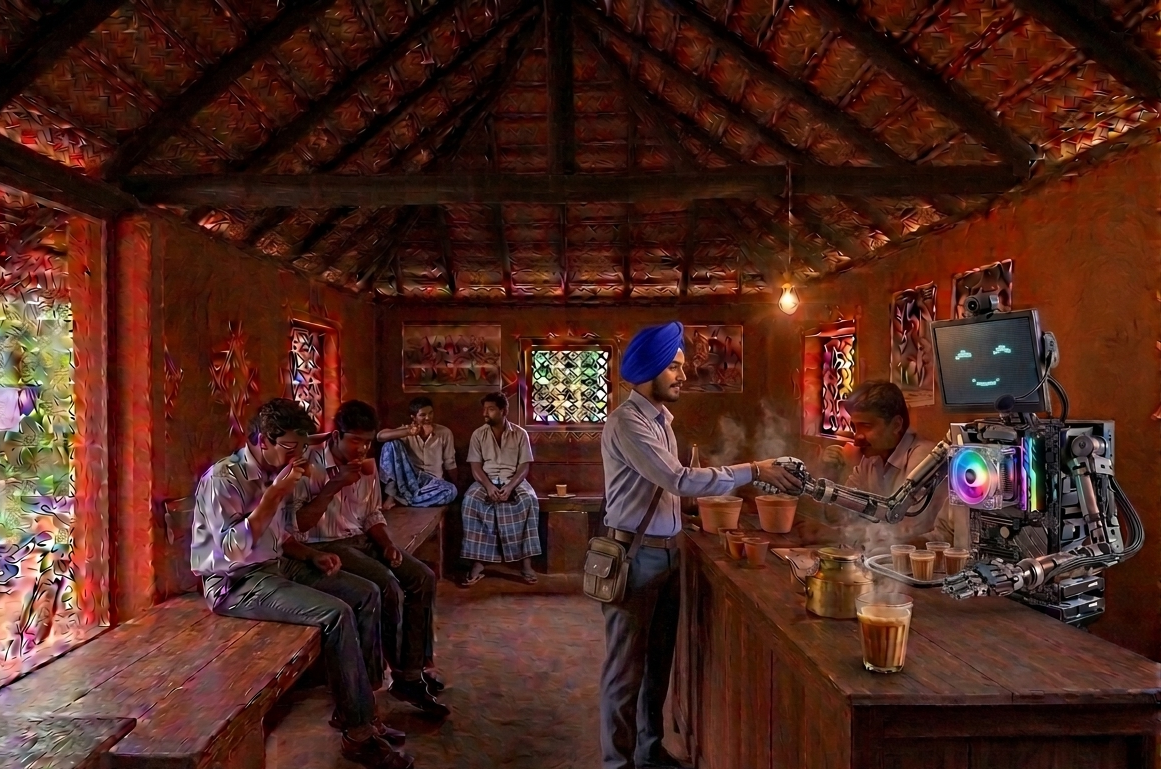
Every generation thinks it lived through interesting times, and I suppose ours has a decent claim — we started out with slide rules and have somehow lived long enough to have actual conversations with AI. So every now and then I find myself wondering, half seriously, what would have happened if AI had turned up in Kattangal back in 1980 instead of forty-odd years later.
Honestly I think we’d have completely confused the poor thing within about a week.
Picture it. One Monday some mysterious machine just shows up on campus, nobody quite knows from where. Someone says a professor brought it back from the US. Someone else swears it came out of some experiment in the Electrical department. And of course there’s always that one guy who insists it arrived by KSRTC bus, because in Kerala, eventually, everything does arrive by bus.
There’d be a notice put up somewhere — “Artificial Intelligence installed on campus for academic purposes” — and that phrase would survive maybe a day. By Tuesday there’s already a queue. Mechanical students want help with thermodynamics. Civil wants help with assignments. The electronics guys mostly just want to take it apart and see how it works. The computer science lot want to know if it can write programs for them. And by lunchtime, naturally, everyone just wants to know if it can leak exam questions.
It says no, obviously, and I think the whole campus loses a bit of respect for it right there.
By Wednesday it’s ended up in the Mini-Canteen, which honestly is the only place it could have ended up. Someone puts a cup of tea next to it, more out of habit than anything else. Somebody asks it whether capitalism or socialism is better, and it gives some careful, balanced answer, and both sides somehow walk away thinking they won the argument. Someone else asks if India’s going to win the next World Cup and it says it can’t predict that, and some guy mutters something like “then what’s so intelligent about it anyway.”
Then a third fellow, very seriously, asks if he’s going to pass the semester. There’s a pause — I imagine it actually pauses, for effect — and it just says, “that depends.” And honestly that might be the most accurate thing anyone’s ever said in that canteen.
After that it starts getting taken a bit more seriously. People start asking real things — should I do higher studies, public sector or private, is there a future in computers, that kind of thing. And then, inevitably, late one evening, some guy makes sure nobody’s around and asks, quietly, “does she like me?”
It thinks about it for a second and says, “you haven’t spoken to her yet.”
The guy just gets up and leaves. I like to think the canteen actually applauded.
Within a week or so it’s basically just part of the furniture. Every evening it’s sitting there in the canteen while the usual arguments go on around it — politics, cricket, movies, what’s wrong with the country, what’s wrong with the world, occasionally what’s wrong with someone who still hasn’t cleared second semester. And I think it would have picked up pretty quickly that engineering students have an absolutely bottomless amount of confidence about things they know almost nothing about. Though maybe that’s exactly the confidence that lets you learn anything in the first place, who knows.
Even ragging gets a bit of an upgrade. Freshers get dragged in front of it and asked to introduce themselves, and one nervous kid says something like “I don’t know anyone here,” and it just tells him, calmly, that forty years from now he’ll still be talking to some of these same people. Nobody believes it at the time, obviously. But it turns out to be completely right.
Then there’s the part where the hostels get evacuated — the student unrest thing, everyone having to clear out almost overnight, campus going dead quiet. The machine just gets left behind in some locked room, switched off, for three months while everyone’s at home not knowing what’s going on.
When people finally come back, the hostels reopen, the canteen comes back to life, and at some point somebody remembers — oh, what happened to that machine? A few of them walk over and switch it back on. And the first thing it asks, after three months of silence, is “so, have all the problems been solved?”
Nobody says anything for a second. Then someone says no. Someone else says not really. A third guy says it’s complicated. And it just sort of takes that in and says, “fair enough — I’ve been to college too.”
Years go by after that. People graduate, become engineers, managers, some start companies, a lot end up scattered across different countries. One mechanical engineering guy somehow wanders off into systems and software and never really comes back to mechanical at all. The machine, presumably, just sits there waiting.
And forty-five years later, the world actually does invent AI for real.
Which gets me thinking — maybe AI did show up at REC in 1980, just not inside any machine. Maybe it was already there, in the hostel rooms and the canteen, in all those arguments that started with cricket and somehow ended up at philosophy by midnight, in a bunch of nineteen-year-olds asking questions they’d spend the next forty years actually figuring out the answers to. And in friendships that, somehow, distance and time zones and careers and grey hair never quite managed to wear down.
Actually, thinking about it more — maybe it’s just as well AI didn’t show up back then. We might have ended up talking to it instead of each other, and that would have been a real loss. Because whatever intelligence mattered most on that campus, it was never artificial. It was just us, being ridiculous and curious and stubbornly attached to each other, the way only twenty-year-olds can be.