

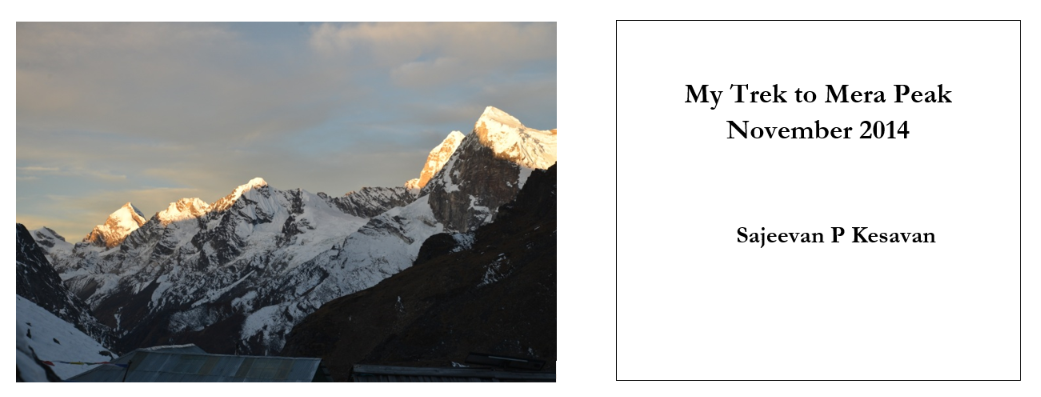
My fascination towards the snow-capped mountains started after I went for the Kailash–Manasarovar trip. Even though I had been thinking about Kailash trip for more than 5 years, I could take it only in 2012. That trip gave me a feel of the high altitude, and the beauty and almost non-polluted atmosphere of the mountains. On the way back from Kailash, I took the ‘mountain flight’ in Nepal for a quick view of some of the 8000+ meter peaks, including the mighty Everest (Nepal calls it ‘Sagarmatha’ with great respect). It was really a thrilling experience for me to see the Everest right in front of me, before the flight made a U-turn to return to Kathmandu Airport. Just a glimpse of that peak charmed me so much that I wanted to see more and more of it. The only option was to trek to the Everest Base Camp and Kalapathar from where one can enjoy the beauty of Everest and Lhotse (another 8000+ meters peak) to heart’s content. So I undertook the EBC trek the very next year, in 2013, and that really increased my appetite to look for higher altitudes. The highest altitude I had reached during the EBC trek was at Kalapathar, @5500 meters.
After completing the EBC trek, I started feeling confident that I could survive much higher altitudes. The question in mind was why not attempt to climb the Everest itself? However, my Sherpa guide (of EBC trek) explained that climbing Everest needs a lot of time, a lot of money, a lot of training and, to start with, trying out other peaks like the 6000+ and 7000+ meter ones to gain experience. His suggestion for me was to try the Mera Peak, which is about 6500 meters above sea level and requires some ice climbing to reach the summit. Attempting Mera Peak will provide the opportunity to trek in some very hostile terrains and also learn the basics of ice climbing.
The representative from Nepal Vision picked me from the hotel at 9:00 am and we went to the rock climbing location. I met the Sherpa at the rock climbing site who would be guiding us throughout the trekking and climbing. I also met Peter who would be my trekking/climbing partner. Peter was a tax consultant from Canada. With the help of the Sherpa and his assistant we practised rock climbing for about two hours and returned to the hotel for lunch and some rest. Later the Sherpa (his name was Dawa) dropped in at my hotel again to check my gear and to help procure additional items from Kathmandu. Together we went to Thamel to buy some essential items such as the sleeping bag, snow goggles, down jacket, medicines etc.
After shopping, Dawa dropped me back at my hotel and asked me to get ready by 6:00 pm to go for the welcome dinner organized by Nepal Vision in one of the typical Nepali Restaurants.
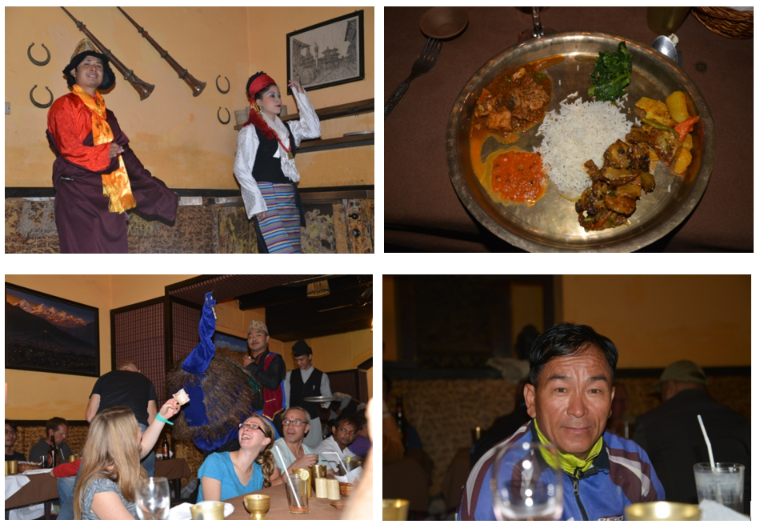 Welcome dinner hosted by Nepal Vision. Bottom right: Dawa Sherpa.
I recalled that during my Everest Base Camp (EBC) trek the previous year, the welcome dinner was hosted at the same restaurant by Nepal Vision.
We finished dinner by around 8:30 pm and returned to our hotel. Dawa requested us to be ready by 6:30 am the next day to go to the Airport to catch the flight to Lukla, which is the starting point for most of the trekking and climbing towards the north-eastern parts of Nepal. Lukla is one of the most dangerous airstrips in the world, which can only support landing and takeoff of very small aircraft like the 14 or 16 seaters. Also the weather changes very rapidly at Lukla and hence the flight operations to and from Lukla will be limited to a few hours in the morning. Considering the unpredictability of the connecting flight from Lukla to Kathmandu, I had already chosen to extend my stay at Kathmandu for two more days after the trekking/climbing trip, to avoid rescheduling my return trip to Bangalore from Kathmandu.
As promised, Dawa reached my hotel at 6:00 am. I was ready and waiting for him. I left the unnecessary luggage and some items for laundry at the hotel to be picked up after my return to Kathmandu. The hotel guys were happy to help with everything. We reached the domestic terminal within 30 minutes, and Dawa got into action to get the boarding passes etc. Unlike the International terminal, the domestic terminal is just chaos and it is very easy to get lost if you are on your own. We, Peter and myself, left everything to Dawa and settled down in one corner and enjoyed some coffee.
Our flight took off at around 9:30 am and it was a 40-minute scenic flight. As it was Peter’s first flight to Lukla, I suggested that he take a seat at the left-hand side of the plane to get a good view of the snow capped mountains. Peter really enjoyed the view and even tried to take some photos with his small point-and-shoot camera.
Lukla is at an altitude of about 3000 meters. The air was already a little thin so any kind of physical effort required harder breathing. The second Sherpa and the porter were waiting for us at the Airport and they helped us to carry the luggage to one of the tea houses where we had planned for an early lunch. Lukla is surrounded by mountains and we could feel ice-cold wind blowing against us. Dawa advised us to wear additional layers of clothing as we moved towards the Tea House.
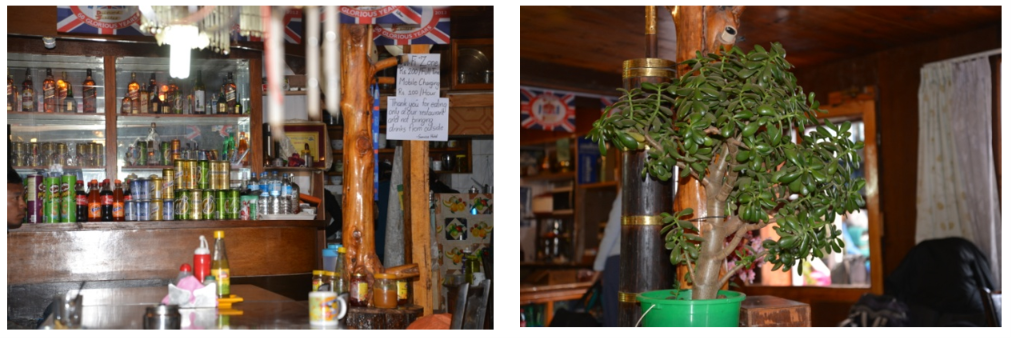 The Tea House in Lukla
Most of the tea houses on the EBC trail were well-stocked. However, as all the supplies to Lukla were airlifted from Kathmandu, everything was very expensive in Lukla. For example, a bottle of mineral water available for NPR 20/- at Kathmandu was costing NPR 100/- at Lukla. And as we moved forward from Lukla, the prices would again increase due to porter charges.
We quickly finished our lunch and the porter was already off with our luggage to the next location. We were expected to gain about 400 meters of altitude within 4-5 hours of trekking to our next tea house which was at Chutanga. As this trekking was after a gap of about one year, I had some difficulty with the terrain and in trekking uphill. Peter also wanted quick breaks in between our first day of trekking.
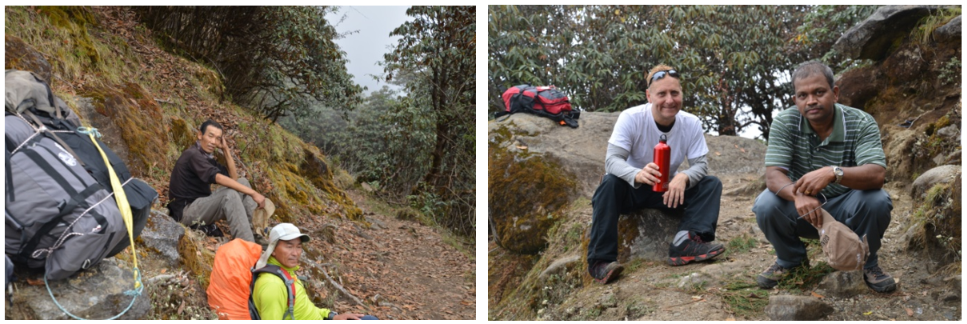
Left: The Porter and the Sherpa; Right: Peter and myself.
As we started sweating due to the uphill trekking, we had to remove the extra layers of clothes that we used at Lukla. The sky was clear, and throughout the trail there was greenery all around. We had to cross a couple of streams on the way. Unlike the EBC trail, there were no bridges across the streams. We had to rely on slippery pieces of rocks or sometimes pine tree trunks kept across the streams. Without any major incidents, we reached our destination by around 5:00 pm. Both of us were exhausted and it was foggy and very cold up there. The Sherpas served us some hot tea as soon as we reached the Tea House and we sat in the dining hall of the Tea House waiting for the owner to start the heater.
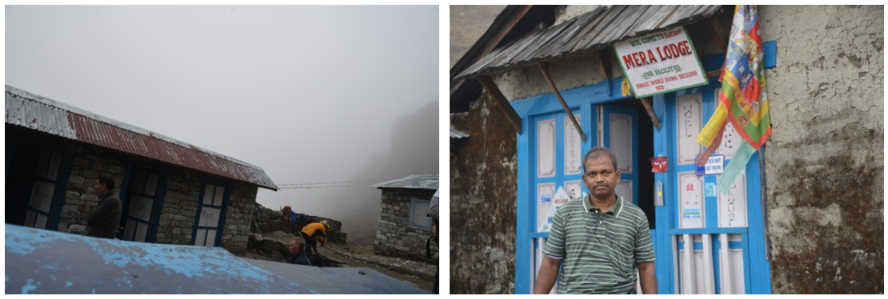
Mera Lodge at Chutanga.
Unlike in the EBC trail, all the lodges along the Mera Peak route charge additional payment for the heater. Heater is nothing but a fireplace that will be started at around 5:30 pm and typically lasted till 7:30 pm. We could see that the heater charges varied based on the altitude. As the altitude increases, firewood needs to be sourced from lower altitudes and the porters, along with other essential supplies, have to carry the firewood also.
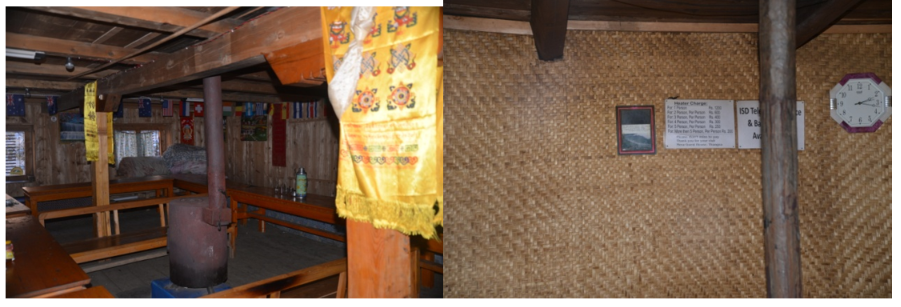 Left: The metallic structure in the middle of the photo is the heater.
Right: The note on the wall displays the heater charges per person.
The photos above were taken at a different tea house than the one where we stayed and are included here to illustrate the common design of the heater used across all the tea houses.
After having an early dinner, we retired to the cold and dark (no lights in the room) for a good night’s sleep as the second day of the trekking was expected to be too demanding and fairly long.
I think I slept well inside the sleeping bag. I woke up hearing the knocks on the door and the Sherpa was ready with some hot tea at the door. It was 6:30 in the morning and the room was ice cold. Peter found it very difficult to come out of the blanket. We both finished the tea and I washed my face with ice cold water. Breakfast was ready and we rushed to the dining room. Something to be noted here is that we don’t get ready the usual way and wait for breakfast to be served. Instead, as soon as breakfast was ready (we may not even have brushed our teeth) we were supposed to eat it and then ‘get ready’ if there is time.
We started our second day’s trek at 7:30 am. The porter was already on his way ahead of us. Looking at the schedule provided to us, we knew that the second day would be really very challenging as we needed to pass Zatrwa La which is at 4600 meters. This would mean an altitude gain of 1200 meters in a few hours of trekking.
As we started gaining altitude, the forest cover started disappearing and we could just see smaller plants (see the first photo below) and then barren land mostly covered with snow. We took a break at a tea shop on the way. We were already at 4100 meters now and we could see the snow covered sloppy mountain to be trekked up to reach Zatrwa La.
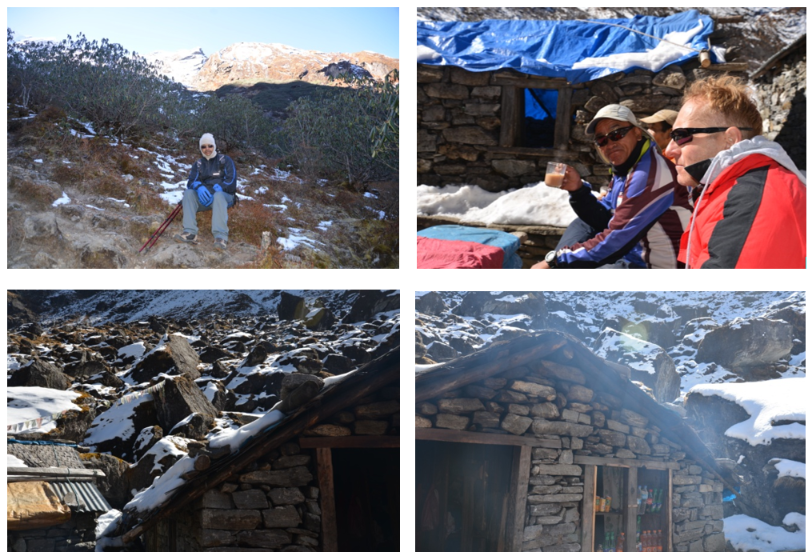
On the way to Zatrwa La.
We refilled our water bottles and started negotiating the way up over the slippery ice buried below the snow and unstable boulders. It was hectic, and both Peter and myself were finding it very hard to breathe.
Though it was ice cold, we started sweating due to the massive efforts required in trekking up. We could take a break only at places where there were a few stones not covered by snow, as seen in the photo below.
Part of the trail to Zatrwa La.
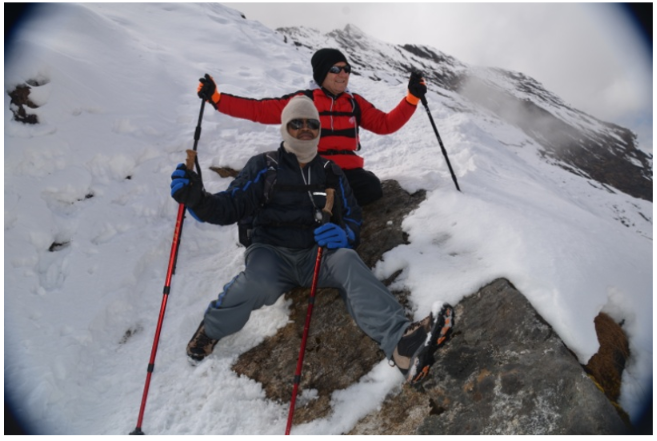
After about two hours of steep upward movement, we could spot the Tibetan flags at the top. As we reached the top, it was foggy and the porter was already there waiting for us.
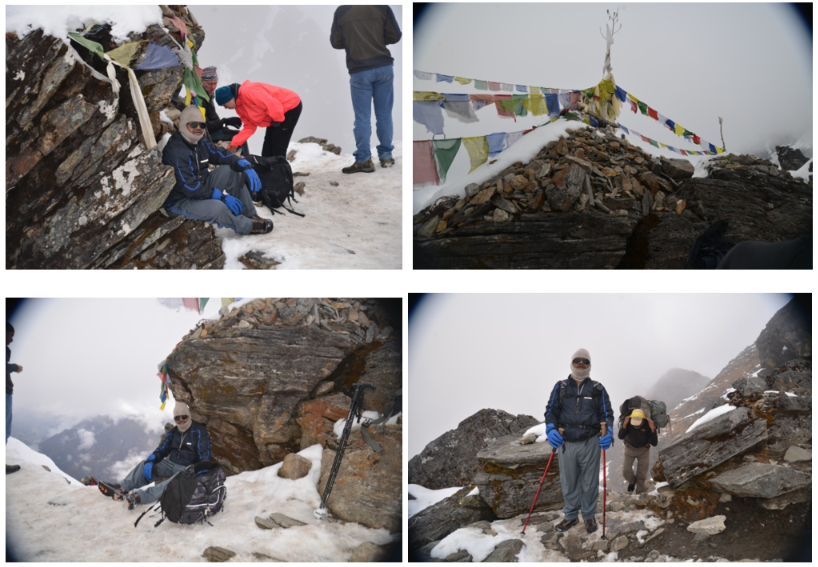
The above photos were taken when we took a break at the top of the pass.
We did not use crampons to walk through the snow in this section. Instead, we relied on carefully stepping on stones successively or on loose snow to move forward.
It was time to trek down from the pass to reach Tuli Kharka which is located at a lesser altitude than the mountain pass. Trekking down was equally difficult as the trail was filled with snow and ice in many places. The Sherpas were patiently helping us, pointing to the right stone or the area on the snow to make our next step. The movement was painfully slow.
As we trekked down further, the trail became better without snow and ice and we could see from far our next location for a night’s rest. We reached Tuli Kharka at around 4:00 pm, that is more than 7 hours after we left the previous location, Chutanga. The altitude at which Tuli Kharka is located is about 4,250 meters. As we had been taking medicines to prevent altitude sickness, we did not face any issues except for lack of appetite and inability to sleep due to breathing problems.
As usual, we retired early to sleep after finishing dinner. However, as there was not much time to acclimatize to the altitude (it was just two days before that we left Kathmandu @1400 meters), we had difficulty in breathing throughout the night. Also, consumption of Diamox forced us to make frequent trips to the rest room in the night. It was a very cold night and I am not sure whether I could sleep even for one hour during the night.
The day was expected to be easy as the trekking would be downward to reach the next tea house which was located at an altitude of 3600 meters. We would be losing about 650 meters of altitude during the trek.
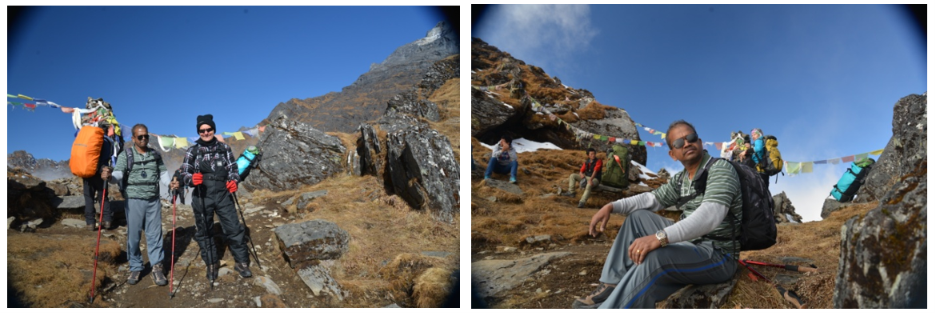
The day was clear providing very good views of the mountains all around till we came down below 4000 meters.
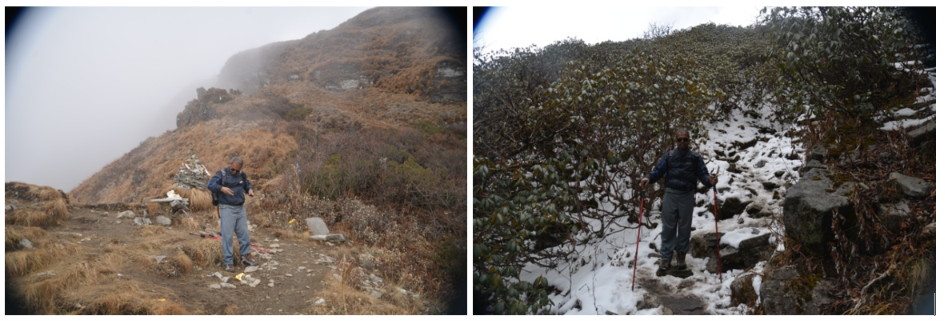
As we came down further, there was fog obstructing the view and the temperature dropped drastically as the sun was hidden behind the fog. Again small plants (see the photo above – bottom right) started appearing and the trail had a mix of boulders and snow making the downward trek very difficult for some time. As the trek was downward, we were not gasping for air and we did not take many breaks except for having lunch on the way.
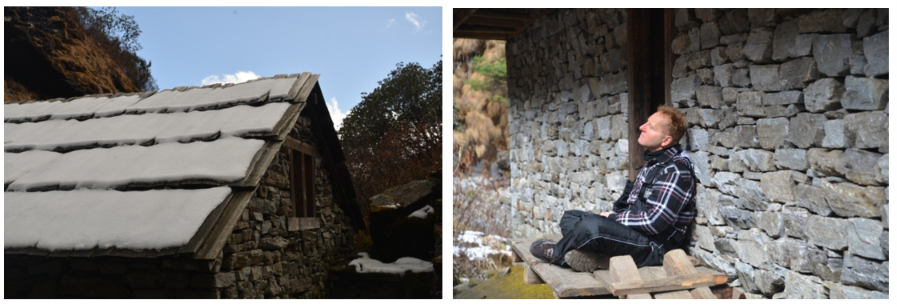
Lunch break on the downward trail. Peter can be seen in a pensive mood.
As we trekked further down, the greenery started appearing again and we were on our way to the Hinku valley and to the shore of the ‘recently’ formed Hinku Valley River after a breach in one of the lakes in the upper regions in 1998.
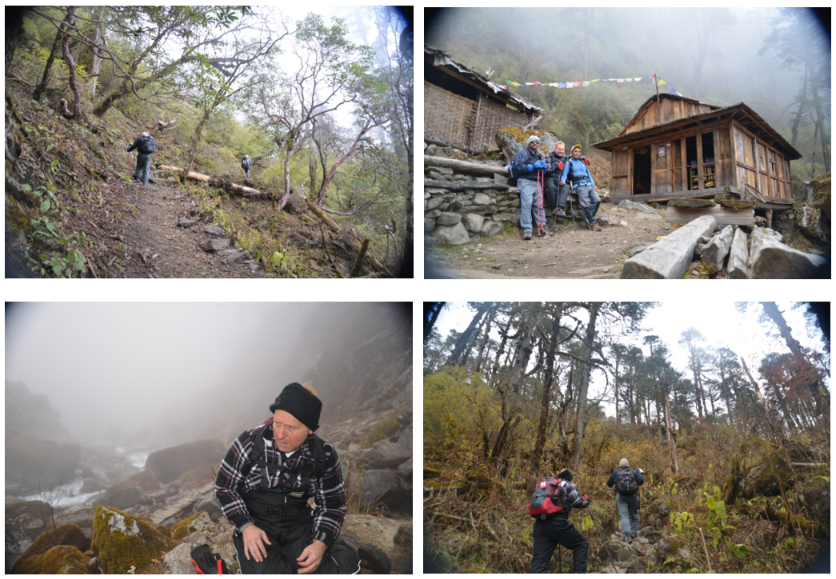
Bottom Left: Hinku Valley River can be seen in the background.
There was a little bit of upward trekking after reaching the shore of the river. As the river was formed recently, the trail alongside the river was quite dangerous due to its slope, loose soil, and unstable rocks. I could not photograph that stretch as the first priority was to pass that stretch safely and as quickly as possible, as the area was prone to frequent landslides.
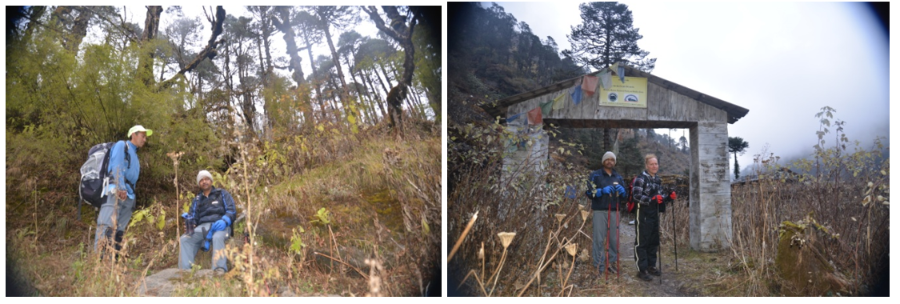
Makalu-Barun national park
Finally, we reached the entrance of the Makalu-Barun national park at around 4:00 pm. Soon after that we reached the Tea House at Gothey. We were happy to see that the heater charges were less here and I assumed that it is because of the availability of firewood in plenty due to the location’s lower altitude.
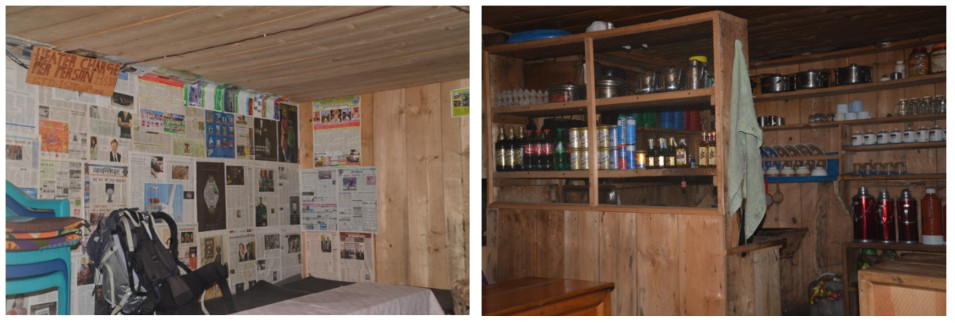
Tea House at Gothey. Left: The note on the upper left corner of the photo displays heater charges.
I was tempted to have a drink as we were at a lower altitude and the risk of altitude sickness would have been low. However, I chose not to, till I return from the summit.
Gothey was cold. However, the place felt much better than Tuli Kharka because the temperature did not go down drastically towards the evening. Also, Dawa told us that the next day’s trek would not be as tedious as the second day’s where we had quickly gained a lot of altitude to pass Zatrwa La. Even though we would be gaining altitude the next day to reach the next location which is Thagnag at an altitude of 4350 meters, it would be over a period of 6-7 hours, the trail rising gradually.
Another thing that needs a mention here is that the number of people trekking to the Mera Peak is negligible when compared to that of the EBC trail. Most of the tea houses where we stayed overnight were hosting just our group, or maybe one other smaller group at the max. Our trekking was towards the end of the season, and I really started wondering how those tea houses will survive without doing any business for the next 3-4 months.
Throughout these trekking trips, evenings were generally relaxed, people spending their time reading, listening to music or making notes etc. As there was nothing else to do, people often waited in the dining room for the dinner (normally served between 6:00 and 7:00 pm) enjoying the warmth from the heater. As soon as the heater dies off, everyone would retire to their rooms to catch up on some sleep. By that time the Sherpa would have spread the bed, organized the sleeping bag and the blankets in the room. I think I slept very well that night, possibly due to the lower altitude or due to lack of sleep during the previous night.
Thagnag was our next destination where we would spend a day for acclimatization and rest after the hectic schedule so far. As mentioned earlier, the trail gradually ascends to 4350 meters and therefore it was a moderate trek. At Thagnag, we would trek to a higher altitude and come down quickly (if necessary) to check our ability to go further up.
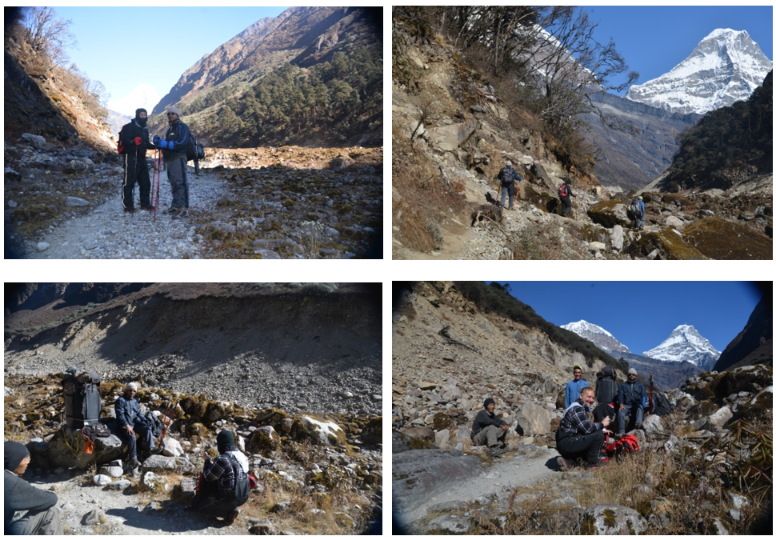
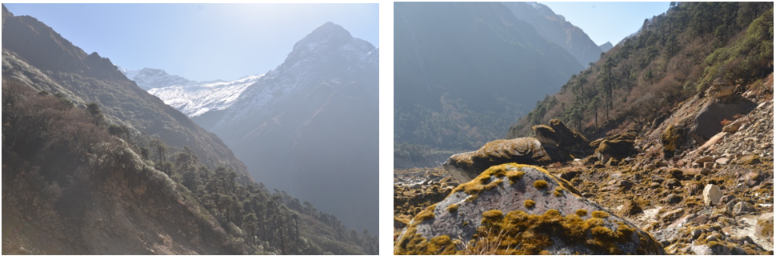
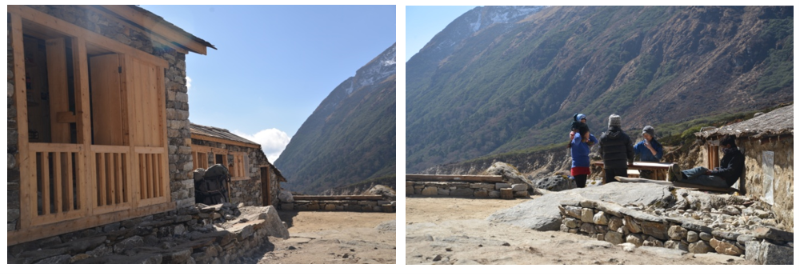
On the way to Thagnag and at Thagnag.
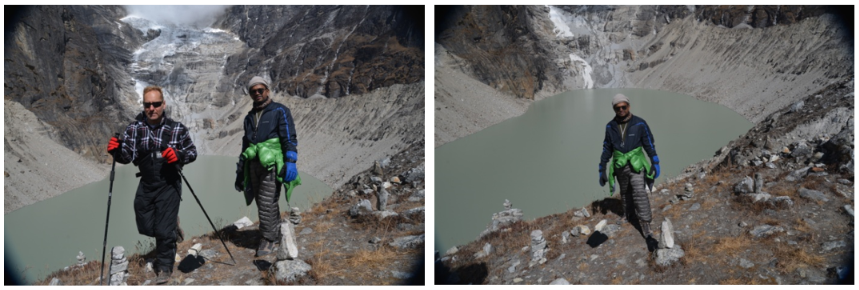
We trekked to a nearby mountain to gain higher altitude experience, as was planned for the day. This was to check whether the trekkers can sustain higher altitudes at remote areas. Trekking to higher altitudes closer to inhabited areas is less risky as help is easily available in case of a need for immediate evacuation to a lower altitude. We went about 400 meters up to visit a lake that is believed to be formed less than 2000 years ago. See the pictures below.
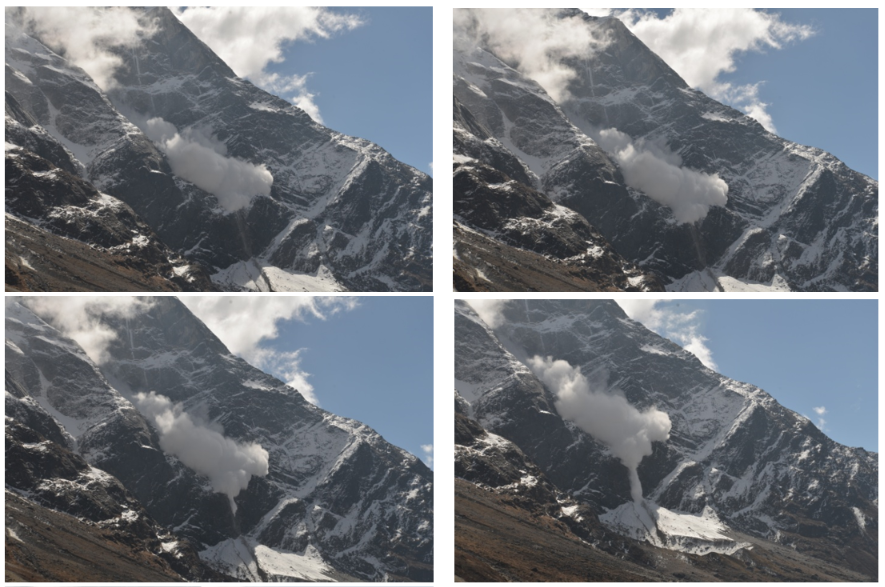
After we returned to the base, we were also able to witness (first time for me) an avalanche on a nearby mountain. It came down with a deafening sound. Unfortunately, I could not capture the avalanche in my handy cam. However, our Sherpa was able to shoot a series of stills using my SLR camera. Everything got over within a minute and this is the only thing that Sherpas fear in their life. See the sequence of shots of the avalanche below.
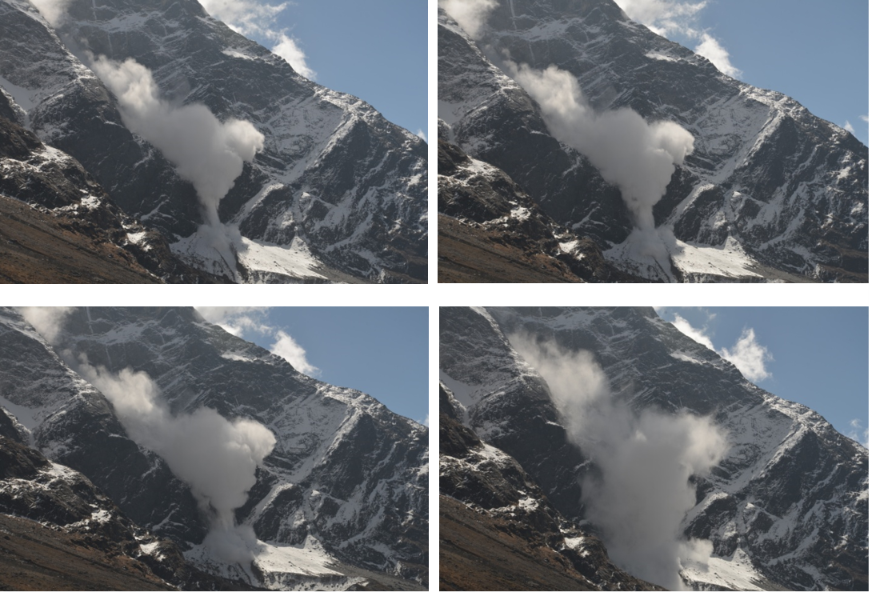
After having lunch at Thagnag, all of us got some rest. It was a sunny day and I spent some time preparing notes etc.
Khare at 4900 meters was the next destination. The last tea house on the trail to Mera Peak is at Khare. After Khare, it requires establishing two camps before attempting the summit. The first one is the Mera Base Camp at 5350 meters and the second one is the Mera High Camp at 5750 meters. The trek to Khare took almost 6 hours due to the steep climbs required on the way and the trails mixed with boulders and snow at certain places. Sometimes the trail was along the slope of recent landslides making it difficult to traverse. Every step required attention and care.
We could view Khare from far away locked between the mountains. We were tired already and hoped that in a matter of minutes we should be reaching Khare. But it took almost one hour after having our first view of Khare to reach there.
Khare was very cold and we were lucky to get accommodation in a better tea house there. Unlike the other tea houses where we spent the previous nights, the Tea House at Khare had semi transparent roof top that let in a lot of sun light during the day and kept the dining room relatively warm. I preferred to have an energy drink instead of tea, as I was totally exhausted by the time we reached Khare.
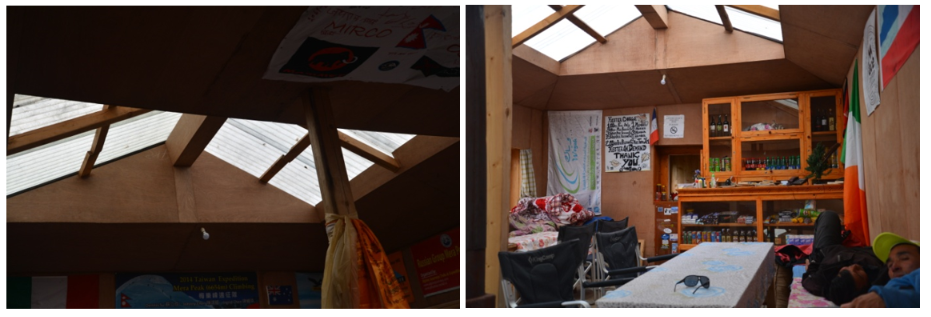
The Tea House at Khare.
The mountains were lit by the moon light and looked heavenly in the night. I really did not want to miss the scene and ignored the biting cold to capture a few shots.
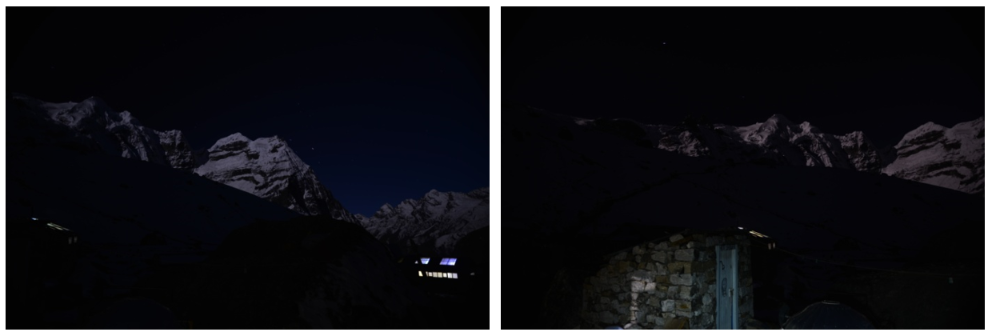
Night view at Khare.
Stars look like streaks as the exposure was for 1 minute for the above pictures. For the second photo (right), I used my torch to illuminate the nearby stone structure while the exposure was on.
It was the second acclimatization day of the trek as we had already reached an altitude at which physical as well as psychological changes can occur that can lead to mountain sickness. Peter was looking a little gloomy after reaching Khare the previous day. I was not sure whether he was simply tired or mentally stressed out or both. I was really stressed out as, after leaving Kathmandu, there was no chance to take a shower or change my clothes. Having food was another issue, as at higher altitudes, aversion to food is a common problem. Both of us were physically tired. Hence we felt that this was the day for us to de-stress and get rejuvenated. I started abandoning hot tea as it significantly reduced my appetite for food, instead relying mostly on coffee or plain hot water.
As per our schedule, it was the day to practice ice climbing. The final leg of the trek requires ice climbing to reach the summit. So it was important to gain some experience in using the rope and other climbing equipment. Also, the specialized gear required for our trek over the snow and ice for the next three days will have to be hired from Khare.
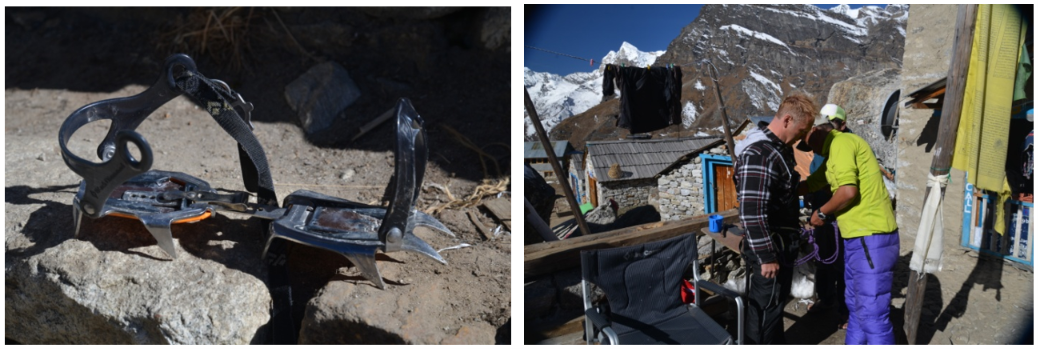
Left: The crampon that will be tied to the specialized shoes to trek over snow and ice. Right: Dawa helping Peter to wear the gear required for ice climbing practice.
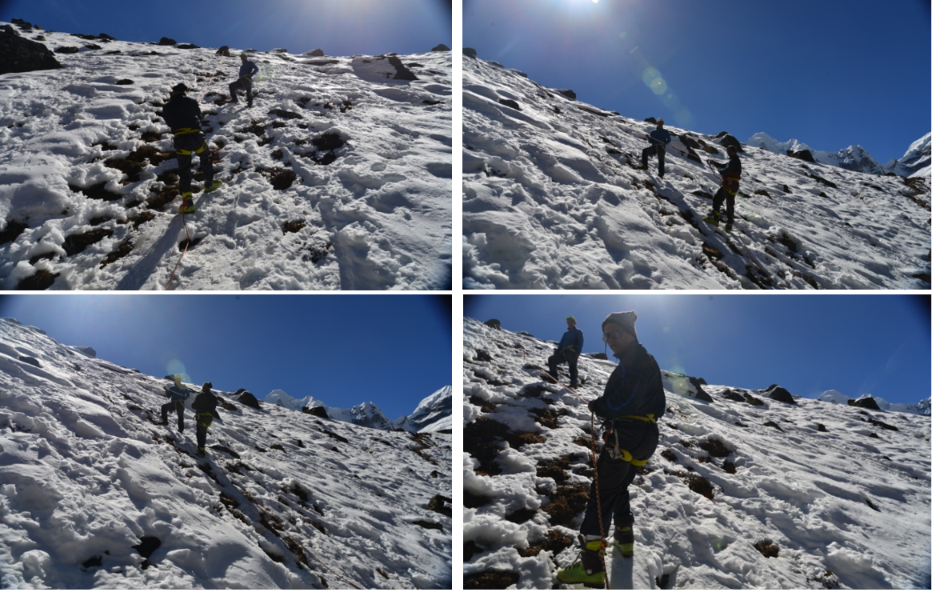
The ice climbing practice session at Khare.
After getting familiarized with the ice climbing equipment and their usage, we returned to the Tea House for lunch and took rest throughout the afternoon.
From this day onward, the team was on its own without any local support till the summit day. We had to carry all the supplies necessary for survival including tents, small cooking gas cylinders and ready-to-cook items. As per the schedule, we should establish the Mera Base Camp by evening. The whole trek was over thick snow and frozen ice. Some of the earlier trekkers had marked the trail by inserting small sticks over the snow. As the wind velocity was usually higher, the footsteps in the trail get covered by the snow, and the only way to stick to the trail was those sticks popping out of the snow. Unless we stick to the trail, the risk of falling into a crevasse is quite high as they get covered with snow.
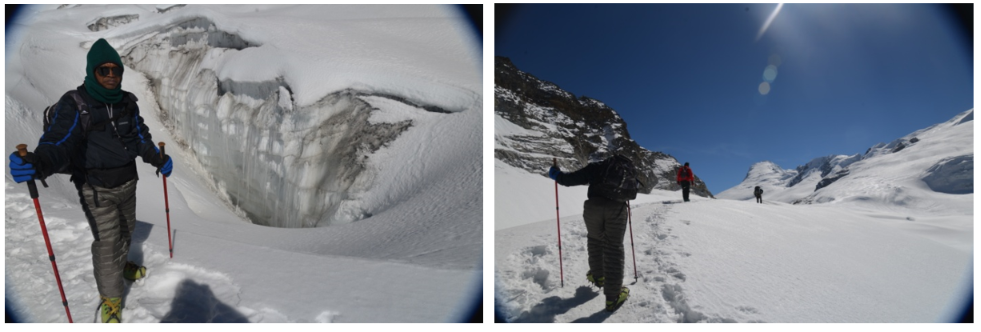
Left: A crevasse is seen alongside the trail. It may get covered if there is heavy snowfall and unsuspecting trekkers may fall inside, which can be fatal.
We had already lost interest in counting the number of hours of trekking by now. We had also stopped asking the Sherpa “How many more hours till we reach the destination?” as we knew that we were terribly slow over the ice. And there was no option to take a break, sit, and relax; our aim was just to reach the Base Camp as early as we could. I felt that my legs were heavier and required extra commands from my brain to make them work!
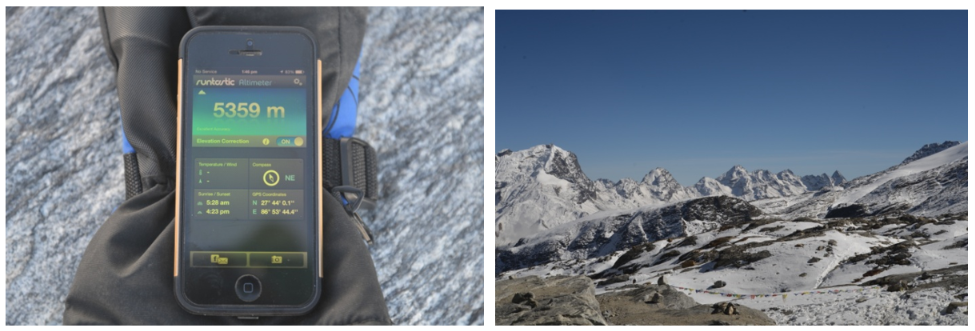
Left: The GPS location and the altitude as reported by my mobile phone at the Mera Base Camp. The altitude is determined by the GPS coordinates. Right: View from the base camp.
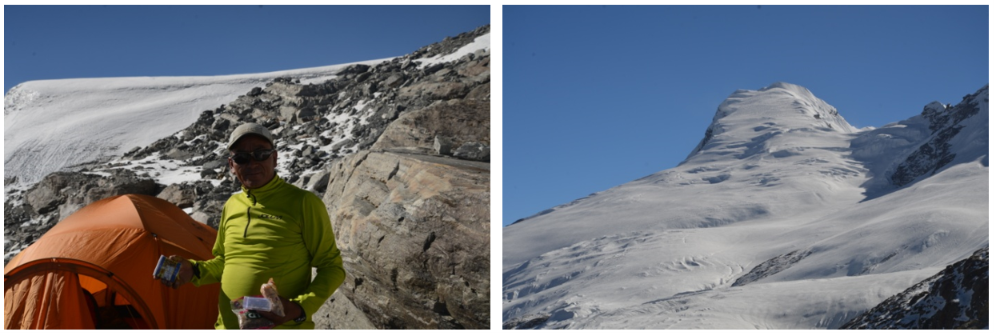
There was nothing else to do at the base camp except to enjoy the view around and click photos. Sherpas collected ice from a little far away (I am not sure why ice and why not snow which was available in plenty all around) and melted and boiled to make hot mango juice and noodle soup. We were too hungry and thirsty and I would say we finished everything as soon as it was served by the Sherpas.
Later, after a light dinner, we all retired to our tents (one tent for the Sherpas and the porter, which was also used for cooking, and one tent for Peter and myself). I was considering taking some photos in the night. However, the fear of being blown away by the strong wind which had started in the night forced me to stay back in the tent. Throughout the night, wind was very furious and I thought even our tents will be blown away. Once again, I was not sure whether I had slept for enough number of hours for the night.
“Good Morning Sir”, the Sherpa was ready with a hot cup of coffee at 6:00 in the morning. I stretched my hand out from the sleeping bag, grabbed the coffee and without coming out of the sleeping bag, in a very uncomfortable posture, enjoyed the aroma of the hot black coffee. Jokingly I asked the Sherpa, “Where is the menu card for ordering breakfast?” Till the previous morning, we had the luxury of ordering our choice of items at the lodges. I think all of them enjoyed the joke that led to a hearty laugh in the morning, probably in several days after leaving Kathmandu.
We were ready after breakfast to trek to the “Mera High Camp”. In a matter of minutes, the tents were dismantled and packed and as usual the porter left us behind and was on the way to the high camp.
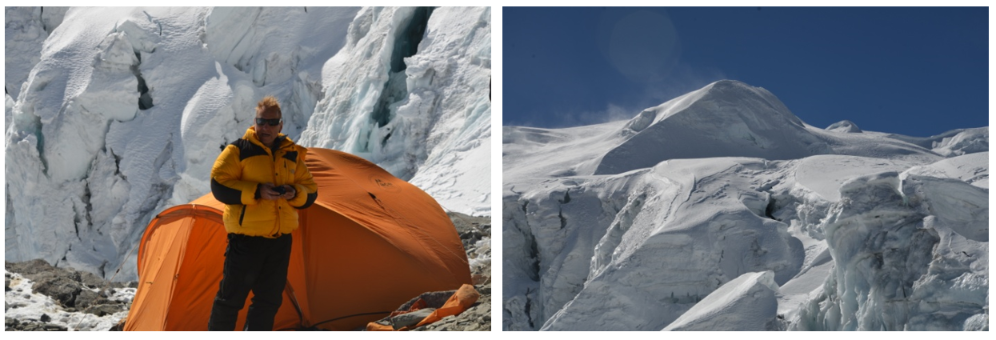
Left: Peter in front of our tent at Mera High Camp. Right: Mera Peak can be seen from High Camp as a small mountain far away.
The cracks in the ice can be seen in the above pictures. These can lead to avalanches as sun rises and the ice melts. This is one reason for attempting crossing huge glaciers before the sun rises.
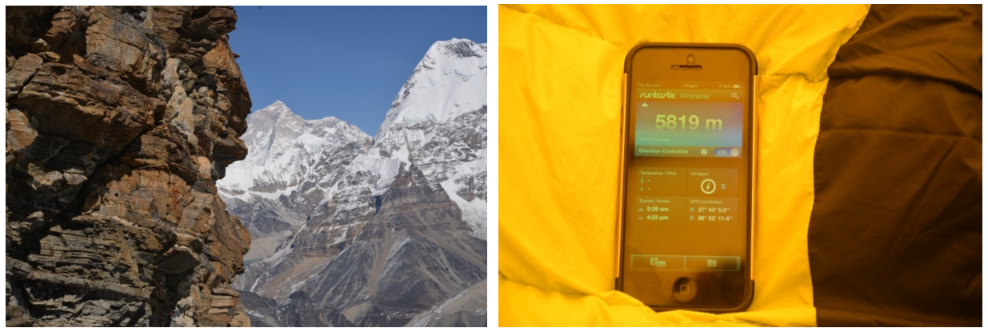
Altitude and coordinates as reported by the mobile phone at the Mera High Camp.
At the High Camp, it was again a day without any specific schedule. As we had planned to start the trek at 2:30 am the next morning, the Sherpa ordered us to sleep early soon after we finished our light dinner at 5:00 pm that evening.
I felt tense and anxious that night. I was not sure whether my attempt to scale the summit will succeed or not. I was tired and felt as if there was no energy left in me to move even an inch further. Till the time the Sherpa called us at 2:00 am, I lay awake listening to the wind shaking our tent and trying to blow it away.
We had a bowl of hot noodle soup and a hot cup of tea and set off for the summit attempt at 2:30 am. The porter stayed back at the camp as we would be returning to the High Camp after scaling the summit by noon, and he took it as his responsibility to cook and serve us a hot lunch when we return.
We tied ourselves together with the ropes using safety clips before starting, the Lead Sherpa at the front, then Peter, myself, followed by the second Sherpa. All of us had our headlights on even though the trail was reasonably visible in the moon light. After about three hours of trekking, we could see the mountains around us getting lighted by the diffused sunlight. Peter was on his knees several times by now as he was finding it very hard to breathe. By dawn, he was totally down on the snow and it became impossible for him to step forward due to breathlessness. Finally he decided to abort the attempt. The ropes were untied and Peter was sent back with one of the Sherpas to the High Camp. Peter wished me good luck and trekked down with the second Sherpa.
We continued to trek upward. Every 10-15 steps, I had to stop and take deep breaths. Dawa was very supportive and kept encouraging me to give my best shot. Though with every step we moved forward to reach the base of the mountain, I felt that the mountain was moving further away from us frustrating me.
By now, sun was already up in the sky and the view around was magnificent. We could see the Everest, Lhotse and Kanjunjunga in the clear weather. I could feel the snow melting on my face carried by the slow winds. But that was not the time to enjoy the view, as we were getting late to reach the summit; the wind velocity could increase as the sun was already up in the sky. Dawa was urging me to move faster.
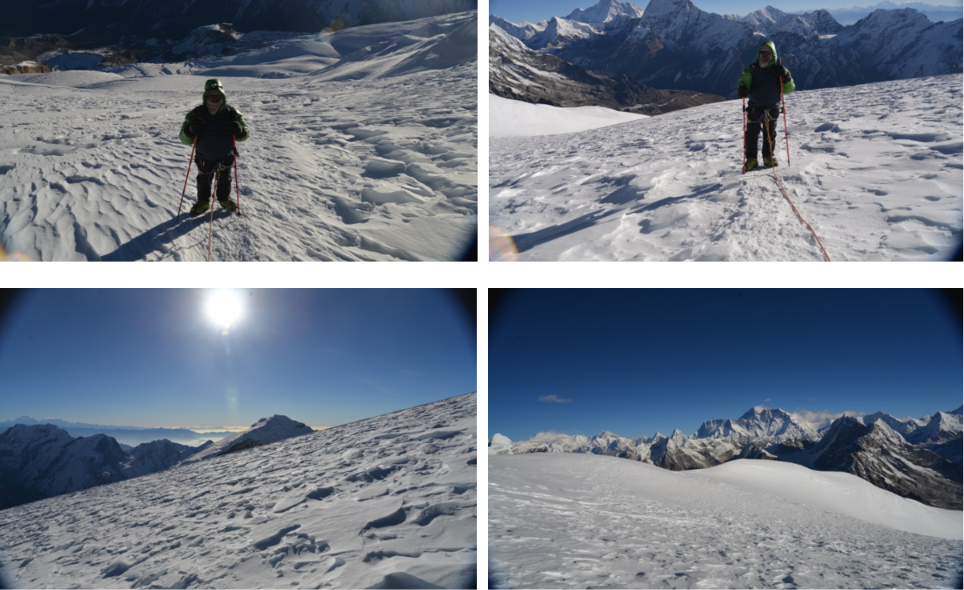
Photos clicked by Dawa on the way to Mera Peak summit. Everest and Lhotse can be seen in the background of the picture on the top right.
Finally, we reached the base of the mountain where the actual climbing to the peak started. Dawa did not waste even a minute. He tied one end of the rope on a hook below the mountain and using the ice axe, climbed to the top of the mountain. The slope was almost 90 degrees and in some places the ice was projecting outward. While I was looking from below and pondering myself around the question “is this something I can really do?”, Dawa had already tied the other end of the rope on a 2-inch metal rod that he had carried along, after hammering down most of it in the ice. Dawa yelled from the top and asked me to start climbing.
When I touched the rope, all my anxieties were gone. I remember having a sense of relief that I was sufficiently insured to cover the future of my family. I gathered all my strength and focused on the climb. I am not sure how much time it actually did take; I reached the top of the mountain which I felt a few minutes before as an impossible task for me. I reached the summit at 9:02 am IST and I thanked Dawa for all his support to help me reach there.
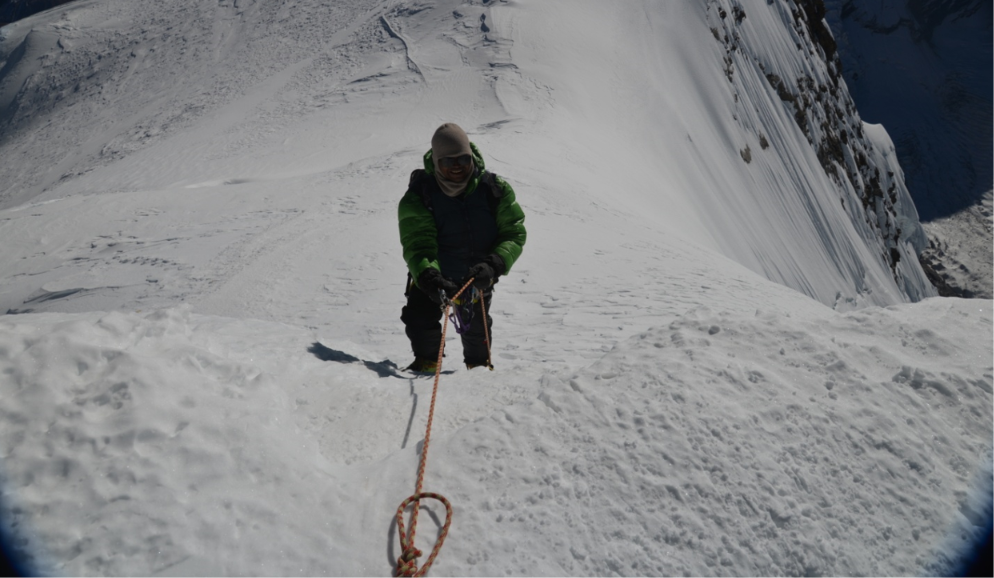
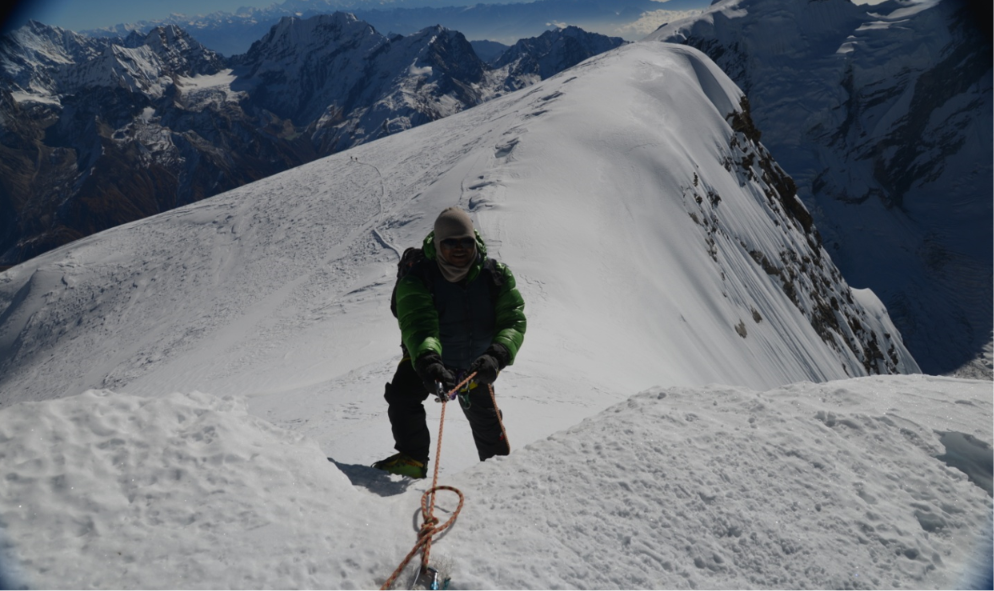
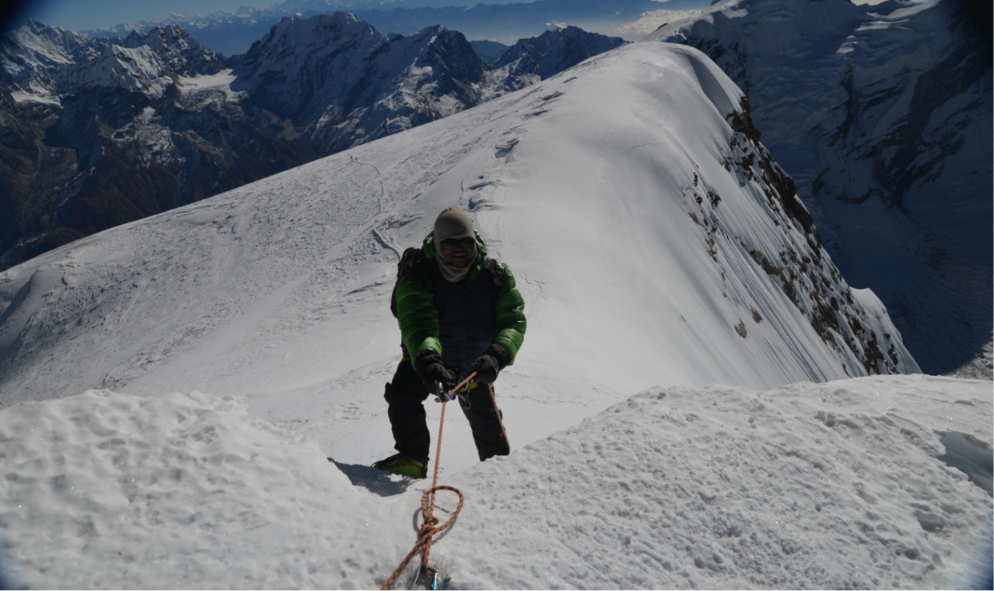
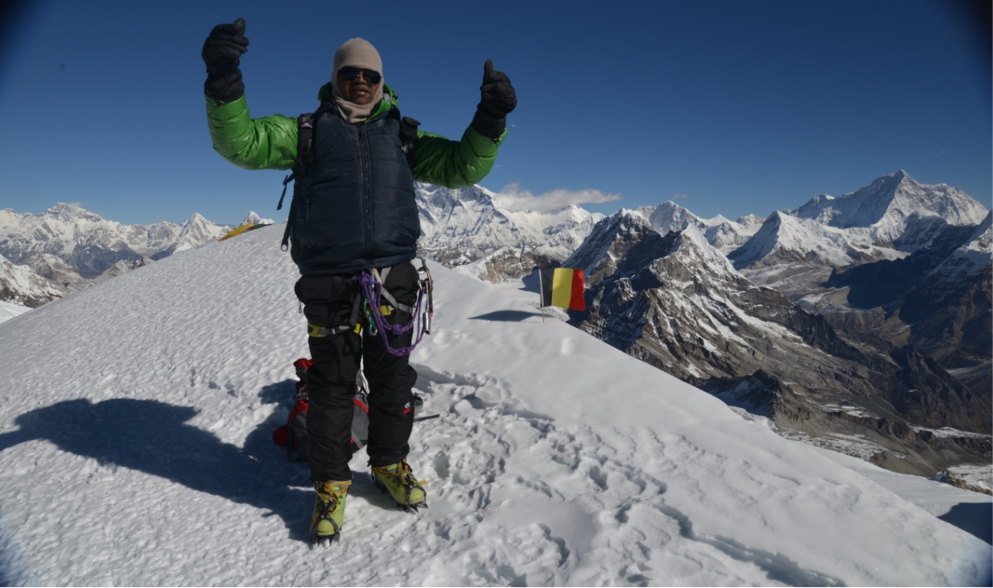
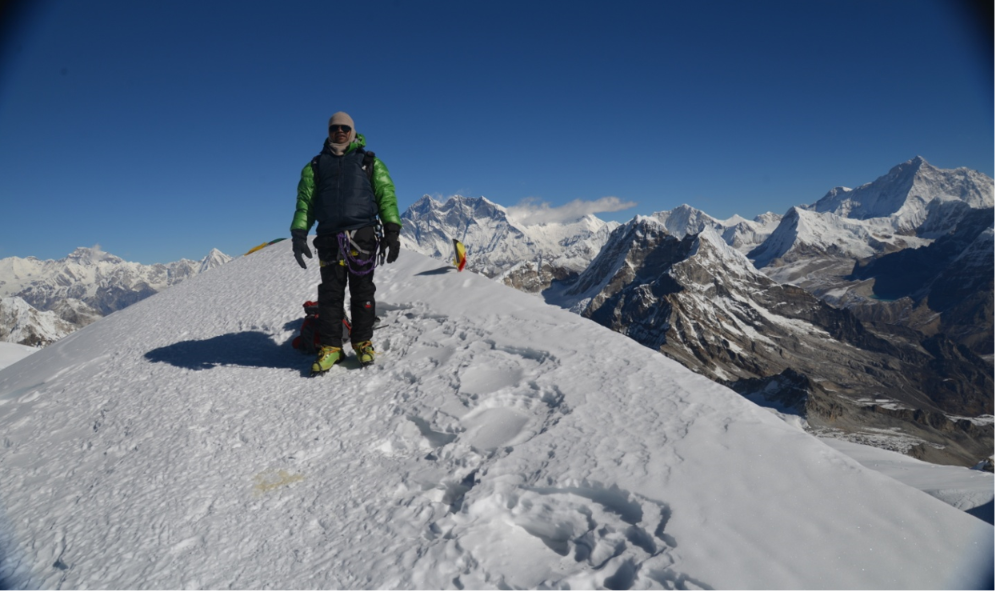
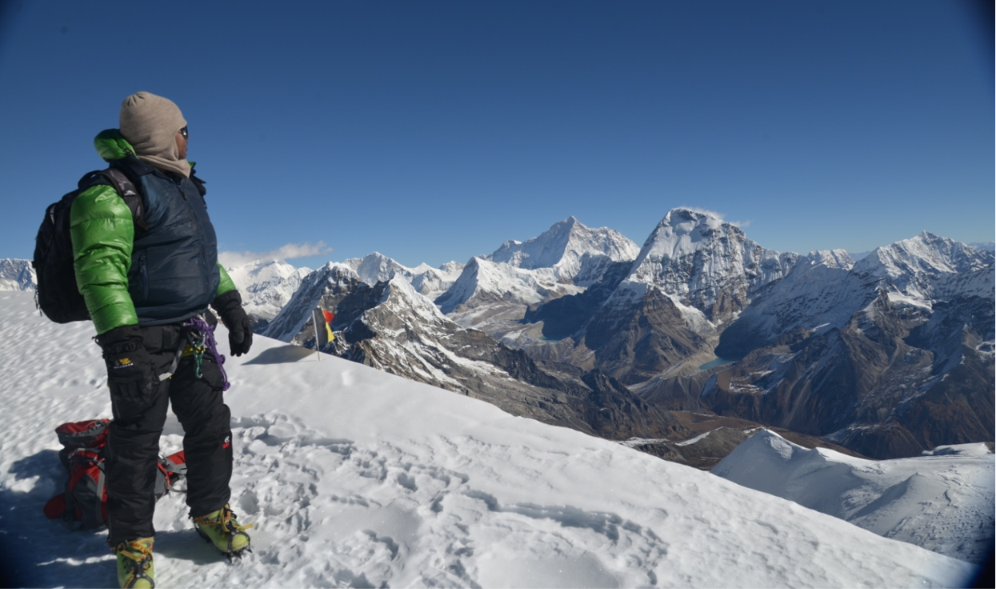
I have no words to describe the view from the top of Mera Peak. It was just amazing. There was nothing in the near vicinity obstructing the view of the majestic Everest and the other 8000+ meters peaks in Nepal and in India. I knew that the last 10 days of hardship had really paid off.
While we were on the top of the mountain we could spot two climbers approaching the base of the peak. Dawa took a number of photos from the peak, but within a few minutes, the camera stopped working due to extreme cold. Wind velocity had started increasing in the few minutes that we were there. The peak was so narrow that people could be blown down by heavy winds. After spending about 6-8 minutes on the summit, Dawa ordered me to climb down using the rope.
By the time I got down to the base of the mountain, the other two climbers we had spotted earlier had already reached there. Dawa was still on the top, working on retrieving the iron rod and the ropes. As I found it difficult to remove the hooks from the rope, those experienced youngsters helped me to remove them and tied me to the hook below, where the lower end of the rope was tied, to secure me till Dawa came down.
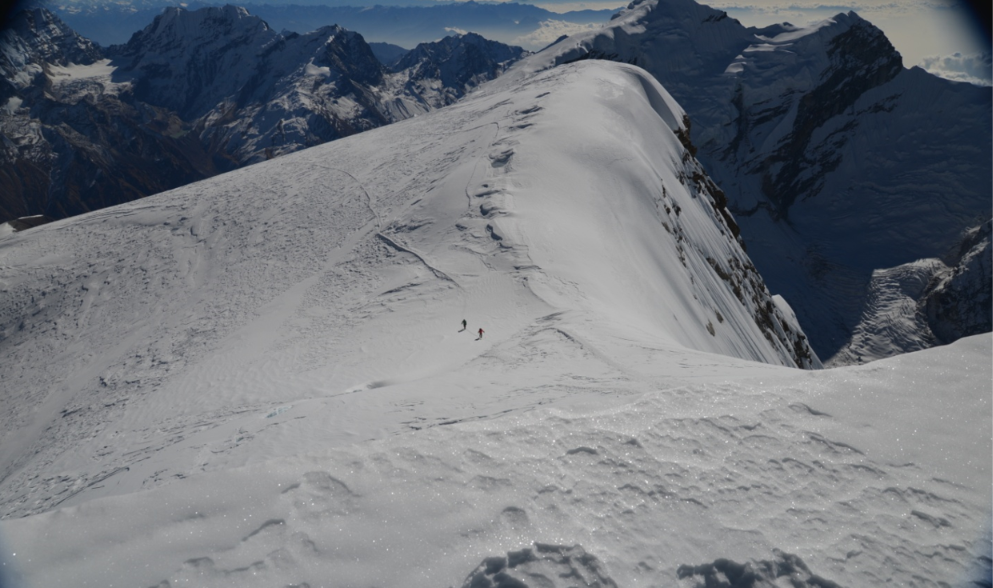
View from the top where the two climbers approaching the base of Mera Peak can be seen.
The return to Mera High Camp was comfortable to my lungs as it was a downward trek. However, the shoes we had rented from Khare were not really fitting me and gradually they started hurting my toes. The pain became unbearable after some time and I feared that my nails will come off.
We reached the High Camp at around 11:30 am. Peter was waiting for us. We finished our lunch quickly and headed straight to Khare. We reached Khare at around 4:30 pm. We trekked for more than 13 hours during the summit day!
Even though it was really a tiring day, I felt exhilarated about my accomplishment. I was not that optimistic about reaching the summit considering the difficulties I faced in my previous trek to EBC.
After coming back to Khare, I started thinking about trying still higher peaks and decided to speak to Nepal Vision once I got back to Kathmandu.
Of course, I had discussions with Nepal Vision after I returned. I was a bit disappointed when I went through the details. The most deterring factor for me was the exorbitant cost involved in climbing a 7000+ meters peak. My dream to scale further altitudes has hit a definite roadblock, but of course I will find a way.
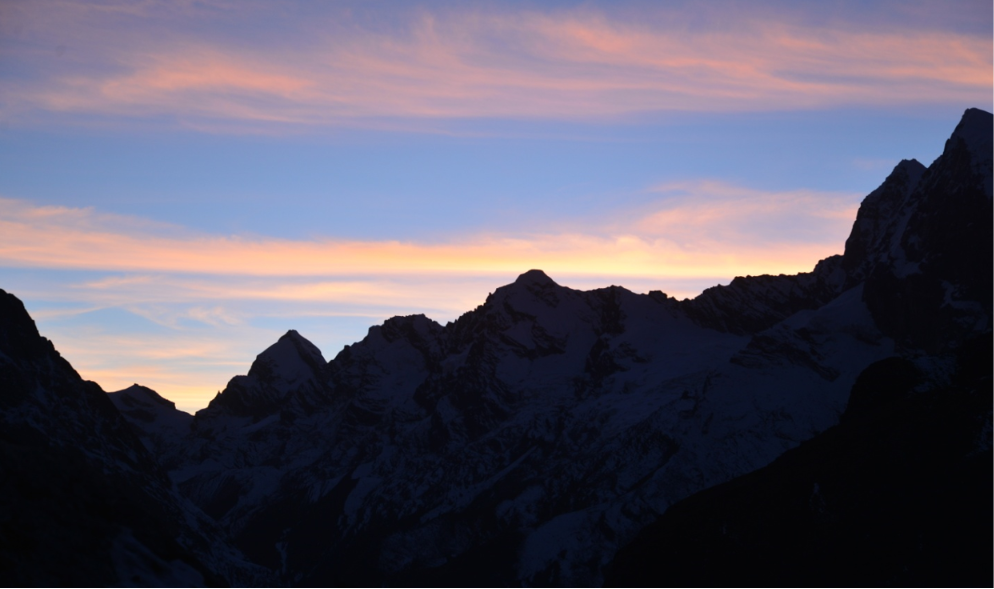
A view of Khare in the evening. This photograph was taken before we left for Khare towards the Mera Base Camp.