

Rajeev Sunu (1981)
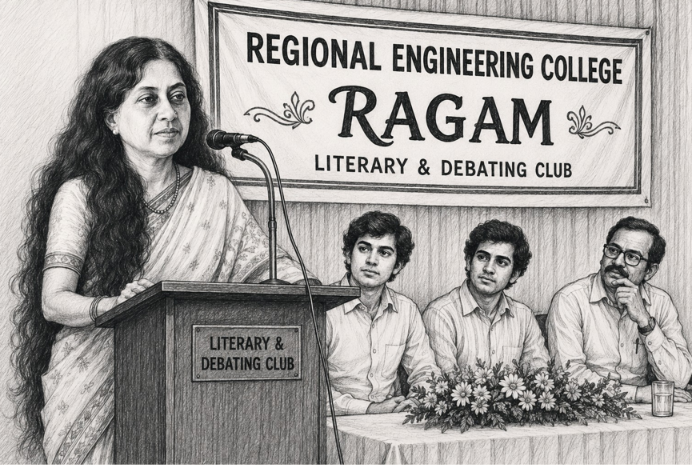
Madhavikutty addresses students at the Ragam Festival, Regional Engineering College, Calicut · August 1981
It was drizzling in Kozhikode that August morning in 1981 — the kind of rain that does not so much fall as breathe, a fine wet exhalation of the monsoon, softening the edges of everything. Jose and I stepped out of the auto-rickshaw at her gate smelling of campus soap and nervousness. We were eighteen-something boys from the Regional Engineering College, living in that narrow, testosterone-bright exile between the Chathamngalam and Kattangal villages, where the only women were dreams, dog-eared pornography magazines passed from hand to hand in the hostel dark, and the night-shade women of Kattangal — the ones who existed in whisper and shadow at the illegal margins of the nearby villages, available to those willing to pay and to pretend, afterwards, that nothing had happened. We had come to invite Madhavikutty to speak at Ragam—our festival for Rajan, the boy the police had beaten to death in the Emergency years, the beautiful boy whose face was now a flex banner at our gate.
I had read her, of course. Everyone had. Her confessions arrived in Malayalam like contraband—nakedness dressed in perfect syntax. She had written in My Story of desire without apology, of the body as a site of both sovereignty and grief, of men who arrived and departed leaving behind only the faint phosphorescence of their attention. She had said, somewhere, that she wrote to survive what she could not speak aloud. Standing at her gate, I did not yet know that she had also told Merrily Weisbord — the Canadian writer who would spend years at her side and later publish The Love Queen of Malabar — that she had always been drawn to young men, to their rawness, to the way youth makes everything urgent. I did not know this, but I must have felt it, the way you feel a shift in pressure before lightning.
______________________________________________________
She was not simply a beautiful woman. She was the first woman I
had ever seen who wore her own desire like weather — openly,
without apology, as though it belonged to the world around her.
______________________________________________________
She was reclining in an armchair on the veranda, reading. The casual authority of that posture — a woman at leisure in her own body, unhurried — was something I had no register for. The hostel world I inhabited was all right angles: schedules, slogans, the hard geometry of political conviction and academic ambition. Madhavikutty occupied a kind of curved space. Her long black hair moved when she breathed. A male voice — her husband, Madhava Das — was speaking on the telephone inside the house, and the sound of it only sharpened the strangeness of her composure, the way silence deepens beside sound.
I stood there absorbing her. There is no more honest word for it. I was not admiring a poet. I was absorbing a presence — what she herself had described, in those intimate conversations with Weisbord, as the thing that had always frightened men: a woman who existed fully, with no apology for the fullness. She looked up from her book. She smiled. Not the smile one offers visitors, but the smile of someone who has caught you looking and finds the whole arrangement mildly, warmly amusing.
Then, in a near-whisper — conspiratorial, as though sharing a secret the veranda walls should not hear — she said: Close the gate behind you.
Those four words. I turned to Jose without taking my eyes off her and said, Da… close the gate. He understood. You always understood, in moments like that, without being told what precisely you were understanding.
The gate-closing was, I see now, the first of her many small permissions — not invitations exactly, but openings. She had made an art of this, according to Weisbord: the gesture that cannot be quoted in a court of law, the touch that could be denied, the look that said everything while the words said nothing. She had spent decades navigating the scrutiny of a society that wanted her body on display in her writing and invisible in her life. She had married young and unhappily, had desired and been shamed for it, had turned her shame into the most arresting Malayalam prose of the century. She knew every register of desire — its comedy, its devastation, its strange tenderness.
Her husband emerged from inside, stood at the far end of the veranda, and said curtly that the REC campus was full of Naxalites and communists, that there would be trouble if she came to speak, and that she was not well. A brief argument passed between them, low and practiced, the kind that happens between people who have been having the same argument for years in slightly different costumes. Jose and I looked away at the garden, at the rain still breathing on the leaves.
Then she said, firmly and to us rather than him: I will come. I want to see your campus. It made an incredible contribution to free thinking and liberal values in this country. And then about Rajan — the dead boy, the beautiful dead boy — she said simply: He will never be forgotten. I will come.
______________________________________________________
“I enjoyed talking to you boys,” she said. The word landed
differently than it should have — something in the way she
weighted it, boys, as though it named not our age but our
condition: open, unguarded, not yet ruined by the world’s
insistence that we harden.
______________________________________________________
Das intervened on the logistics: their own car, their own driver, back within two hours. I looked at her and she looked at me with that quality of attention she possessed — total, unhurried, as though the moment had all the time it needed — and her eyes said what I have spent decades learning to translate: agree with him, and we will have what we want anyway. I agreed with Das.
She came to the REC campus entrance and the car stopped where we had posted someone to guide her. But she stopped herself first, before any of us could act. At the left-side of the gate there hung a large flex banner with Rajan’s photograph — young, handsome, lit from some internal quality that black-and-white photography can sometimes catch. Beneath it the words I had written:
സ്വന്തം നട്ടെല്ലും തലച്ചോറും ഭരണാധികാരി വർഗ്ഗത്തിന് പണയം വയ്ക്കാൻ കൂട്ടാക്കാത്ത കുറ്റത്തിന്, ഏകാധിപത്യത്തിൻ്റെ തടവറയിൽ, ജനാധിപത്യത്തിനുവേണ്ടി ജീവൻ ബലിയർപ്പിച്ച രാജൻ്റെ സ്വപ്നങ്ങൾക്ക്….
[For the dreams of Rajan… who sacrificed his life for democracy in the prison cell of dictatorship, for the crime of refusing to pawn his own spine and brains to the ruling class.]
She read it. The person we had posted at the entrance told me later that she sat very still for a long time, looking at Rajan’s face with an expression he could not name. He had seen many people stop at that banner. None had looked quite like that. She must have recognized something — not the particular boy but the category of beautiful, mortal, passionate youth that she had made her life’s devotion and her life’s grief. Weisbord would write years later that Madhavikutty spoke of young men as though they were a kind of sacred text: flammable, luminous, requiring careful handling. She had burned herself on them. She had written poems from the ash.
She told the driver: Let us go.
She spoke to a packed auditorium about poetry and its emotive connection with the reader, about the importance of free speech, and then she spoke about Rajan — not as a speech but as a narration, as though she were telling us something she had seen and needed to place in our keeping. She was remarkable on that stage. She had the quality, which Weisbord remarked upon many times, of making a large audience feel addressed individually, privately, as though she had arranged to meet each of them alone and merely permitted the others to listen.
When the applause subsided, I went to her seat on the dais and crouched down beside her. I began to murmur that we had promised to let her go — that the two hours were up, that her husband’s car was waiting. The words were awkward and I knew it. She turned to look at me at close range and smiled — that particular smile again, the mischievous, measuring one — and then, hidden from the audience by the wing of the chair, she reached out and patted my cheek.
Her hand against my face. It lasted perhaps a second. It demolished me entirely. My mouth stayed half open. I got up from my crouch and walked away to the other end of the stage with what I hope was some semblance of composure, though I suspect I was blushing to the hairline. She watched me go.
Later, when she was ready to leave and making her way toward the car, she crossed the stage toward me as I crossed toward her. We met in the middle. She took my hand and held it for a moment — a handshake that was not quite a handshake — and with that womanish gravity she carried like a second atmosphere, she said: Thank you, Rajeev. I enjoyed talking to you boys. I will come again.
· · ·
And then she was gone, and I was walking behind her without having decided to, watching the free flow of her long black hair as she moved — the hair that she had written about, that others had written about, that seemed to carry its own weather — and then the driver closed the door and the car moved and I raised a hand and she was gone.
The word boys stayed with me for a very long time. Not as an insult or a diminishment
— I understood even then that it was neither. In the way she said it, boys was almost a term of endearment, and almost a diagnosis. We were open. We were unguarded. We had not yet learned to protect ourselves from women who spoke truthfully. We had not yet learned to be afraid.
Years later, when she converted to Islam and took the name Kamala Surayya and chose a young man as her companion — a choice that shocked a society that had spent decades consuming her confessions while refusing to grant her their consequences — I thought about that word again. She had loved young men not despite their youth but because of what youth signifies: the willingness to be changed, the absence of the calcified heart. She told Weisbord that she had spent her life giving and giving and giving to men who did not know what to do with the gift. In her final years she seems to have found, in her young companion, someone who received what she offered without flinching.
Merrily Weisbord, who sat with her through years of illness and confession and laughter, wrote of a woman who had turned every wound into language, every abandonment into beauty, every grief into the specific formal pressure of a line of verse. She said that Madhavikutty believed love was the only serious subject. Not romantic love specifically — though she had explored that territory more thoroughly than perhaps anyone in Malayalam literature — but the condition of loving: the vulnerability it required, the attention it demanded, the particular courage of continuing to love a world that kept breaking your heart.
On that drizzling August morning in 1981, on a veranda in Kozhikode, she had asked two boys to close the gate behind them, and what she had been asking — I understand this now, though I could not have named it then — was whether we were the kind of people who could be trusted with an open door. Whether we would close it, or leave it swinging.
She closed it. She smiled.
The rest is what I have spent my life trying, imperfectly, to live up to.
✦