

One Admission Letter and a Thousand Consequences
Manish Chakraborty (1985)
Every now and then I catch myself wondering what life would have looked like if that admission letter from REC Calicut had never turned up.
I’d probably have still found some kind of decent career. Maybe I’d still have travelled a bit. Who knows. But would I be the same person sitting here today, typing this out?
I really don’t think so.
Getting into REC Calicut was a lot more than getting a seat in an engineering college, though none of us realized it at the time. It quietly set off a chain of events that I’m still feeling the effects of, more than forty years later.
I joined Mechanical Engineering, like a lot of us did back then, with that familiar mix of excitement and not really knowing what I was getting into. Genuinely enjoyed most of it, and ended up graduating as University Topper and Gold Medalist. At twenty-two, I thought the rest of my life was basically decided — machines, factories, drawing boards, and engineering calculations.
Then, predictably, life went and did something else entirely.
During my Master’s, I drifted into Systems and Software, and that’s where I ended up spending most of my career, in a field that on paper had almost nothing to do with what I’d been trained for. For years, I genuinely felt like I’d left engineering behind.
I don’t think that anymore.
Engineering, looking back, was never really about the machines. It was about learning how to think. How to take apart a messy problem without panicking. How to see connections that aren’t obvious at first. How to approach things one step at a time instead of getting overwhelmed.
The medal proved I could solve one kind of problem. Life simply kept handing me different kinds of questions to solve.
There’s also something our generation experienced that’s hard to explain to anyone younger.
We arrived at REC carrying slide rules. Every calculation was done by hand, calculators supporting. Assignments were handwritten. If you needed information, you walked to the library because there was no Google. Calling home meant booking a trunk call and waiting, sometimes for hours, for it to connect. Computers were things you heard about rather than things you used.
And now here we are, in the middle of all this Agentic AI.
Sometimes I put my imaginary old slide rule next to my laptop and just look at the two of them for a while.
One belonged to a world where getting an answer required effort, patience and a bit of persistence. The other belongs to a world where machines are beginning to assist us with the thinking itself.
Somewhere between those two objects lies pretty much my entire adult life. And probably the story of our whole batch as well.
But honestly, when I think back to REC, my mind doesn’t go to the classrooms first. Or the exams. Not even the gold medal, really.
It goes to the Mini Canteen.
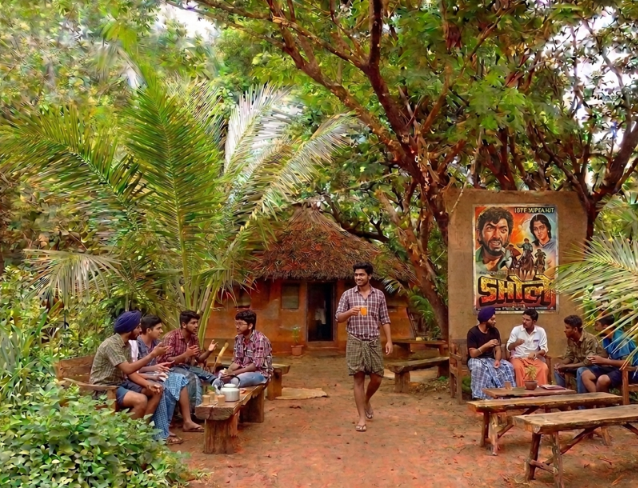
Every college probably has one of those places that ends up mattering far more than it has any right to. For us, it was the Mini Canteen.
The tea was cheap. I honestly can’t remember whether it cost twenty-five or fifty paise. What I do remember is that nobody ever seemed to have enough money, and somehow there was always enough tea.
The things that happened around those benches were priceless.
We argued about soccer, cricket, technology, philosophy and where India was headed — with huge amounts of confidence and almost no information backing any of it up.
Someone would go all in defending an idea. Someone else would tear it to pieces. Voices would rise. Hands would start waving around. Then the tea would arrive, somebody would crack a joke, we’d all start laughing, and within minutes we’d be right back to arguing like nothing had happened.
We genuinely believed, at the time, that we were solving the world’s problems over those cups of tea.
Looking back, the Mini Canteen probably taught us more than half our classes did.
It taught us how to think out loud. How to disagree without taking it personally. How to defend an idea and occasionally admit someone else had made a better point.
Mostly, though, it kept us curious.
I suspect quite a few decisions in our lives can be traced back to conversations that happened around those tables, though none of us knew it then.
Then there was that whole period of student unrest.
Things got serious enough that we were asked to clear out of the hostels, almost overnight. I wasn’t involved in any of it, but when something like that happens, it doesn’t matter whether you were part of it or not. Everyone gets swept up. So we packed our bags and left.
The campus that had become our entire world suddenly fell silent.
No emails back then. No mobile phones in our pockets. No social media. News travelled through rumors, and you never knew how much of it to believe.
We sat at home for almost three months simply waiting. At eighteen or nineteen, three months feels like forever. None of us knew if we’d go back, when we’d go back, or what we’d find when we did.
It took me years to realize what that episode had taught me. Life doesn’t move in a straight line.
Sometimes it simply stops.
Plans fall apart. Certainties disappear. And all you can really do is wait.
And then, one day, we got called back. I still remember walking onto campus again. It didn’t feel like going back to college. It felt like coming home.
The buildings were exactly as we’d left them. The Mini Canteen was still there. People began turning up again, one by one. Within a few hours it felt as though somebody had pressed Pause and then Play. Everything simply carried on.
I’ve noticed since then that life keeps doing this.
New jobs. Moving countries. Technologies changing every few years. Reinventing yourself more than once. Things get interrupted. But most of the time, interruptions turn out to be intermissions rather than endings.
Then there are the roommates.
Forty years is a long time. Long enough for entire careers to happen. Long enough for children to grow up and begin families of their own. Long enough for the world to become almost unrecognizable.
And yet college friendships seem strangely untouched by any of it. These days my old roommates are scattered all over the world. We’ve all acquired titles, responsibilities and considerably more grey hair than we’d like to admit.
Then somebody posts an old photograph in the WhatsApp group. And suddenly everyone’s phone is buzzing.
Someone asks if we remember a particular evening in the hostel. Somebody else says I still owe him ten rupees. Another insists I borrowed his mug and never returned it. Someone is apparently still annoyed that I copied his assignment.
And just like that, forty years disappear.
We’re back in Kattangal. Somebody is arguing about cricket. Someone else is absolutely certain India will become a superpower by the year 2035. Someone is trying to borrow ten rupees. The tea has gone cold and we’re all talking at once.
For a few minutes, we’re twenty again.
But when I think of REC Calicut, I don’t think of either of them first.
I think of the Mini Canteen and the slide rule. I think of walking back onto campus after those three uncertain months.
And I think of a WhatsApp group that can somehow make forty years disappear in less than forty seconds.
That’s the real inheritance from REC. Not a qualification. Not a medal. Just a way of looking at the world, and a few friendships that have stubbornly refused to grow old.