

Kallol Roy (1984)
1.0 Introduction : Apart from the need for growth of the technology and building the necessary value chains through multiple small & medium scale industries, meeting the safety requirements & quality levels demanded by aero, nuclear, maritime industries, there is a significant need for the industry to augment the existing qualified manpower. It is therefore considered necessary to initiate multiple academic and certification programs for start-ups & MSMEs.
1.1 A certification program would be a first step to sensitize the participants on the broad principles of Designing for Safety (be it in aero, nuclear and/or shipping industry); Understanding the Computational tools for Analysis; Codes, Guides & Standards applicable for design of specific Systems, Structures & Equipment/Components (SSE/C); Quality Management Systems (QMS) and the applicable/appropriate Codes. Depending on the engineering discipline, viz. Metallurgy, Mechanical, Electrical, Process, etc., appropriate portions of ISO standards, along with relevant sections of codes/standards/guides from International Engineering Professional Bodies/Organizations, e.g., ASME, ASTM, RCC-MR (for Fast Reactors), IEEE, IEC, etc., need to be considered by academic/training institutes, introduced through both class-room lectures and self-study assignments. Many of the aspects pertaining to the size of the company and the number of team-leads proposed to be certified need to be understood from the best practices followed in various other certification programs.
1.2 It may be noted that the proposed course structure should be much more comprehensive than the focused training modules offered for specific verticals or for specific products or services by other certifying agencies for any part of the aero/nuclear/shipping supply chain. Although one of the prime areas of qualification pertains to a Quality Assurance (QA) program during manufacture & fabrication of Systems, Structures & Equipment/Components (SSE/C), the program should go beyond QMS and QA, and sensitize an MSME in all aspects of design certification, wherein appropriate safety aspects in design and detailed engineering are explained to the participants, including necessary theoretical perceptions, so as to enable their thinking beyond the design.
2.0 Design Certification : The areas that should essentially be the focus of a Design Certification Process by Professional Engg. Bodies, in various disciplines, and work towards offering, include, among others,
(a) Certification for building knowledge & capability development of Aero/Nuclear/Marine Technology Standards (especially instrumental in specifying, testing, and evaluating the materials, instruments, and techniques used in the field of nuclear technology, including Behavior and Use of Nuclear Structural Materials)
(b) Product Certification and Verification with the Safety Equipment Institutes
(c) Certification for Additive Manufacturing (AM)
(d) Certification for a Comprehensive understanding of Geometric Tolerances in Manufacturing
(e) Certification for Design, Layout and Routing of Piping/Ducting and the Analysis required for Pipe-Supports/Hangers, etc.
(f) Certification for Ventilation Requirements in closed spaces
(g) Understanding Electrical Standards for Qualification of Equipment used in Aero/Nuclear/Marine Facilities
(h) Understanding Standards for Qualification of Process Equipment & Roto-Dynamic Equipment used in Aero/Nuclear/Marine Facilities
(i) Standards for Process Safety, etc.
2.1 Faculty for Certification Program : It is envisaged that the academic content of each of the topics would be developed/delivered by Academic Institutes and the Industry together, based on presentations made by members of Professional Bodies relevant to the particular industry, who would in any case have built a career in the industry and may continue to remain as consultants to industry. In such an arrangement, the faculty for classroom training for a certification program would be drawn from both academia and industry, and the portions segregated meaningfully.
3.0 Suggested Framework for Certification Program : A typical course consisting of theory lectures for 3 hours per day (evening class, web-based) — making it 15 hours per week, spread over twelve to sixteen weeks — may be considered a substantial program as a starting point. There may be a requirement of fine-tuning the number of hours per course for any subject in a particular discipline. The table at the end of this article gives a typical suggested framework for such a program.
3.1 It would also be a good practice to carry out a pre-assessment of the MSMEs & start-ups wanting to register for such certification programs, which would help in identifying areas of non-conformance or weaknesses and allow to correct the deficient areas prior to a specific accredited certification process. Receiving a non-conformance alert from such pre-assessment/evaluation program would suggest that a particular area of the design/development system is yet to have reached the level of compliance required by specific codes/standards. This would further help in stream-lining such a program and thereby building a superior eco-system for undertaking design of SSEs/SSCs for the aero/nuclear/marine industry.
3.2 Specifically w.r.t the nuclear industry, it would be a requirement to also undergo a course on ISO-19443, for Quality Assurance during Manufacture, Shipping to Site, System Integration at Site, and Post-Erection Checks. Such a certification should enable a manufacturing company to ensure that all processes pertaining to QA, across the total manufacturing and supply chain cycle, meet the quality standards of the nuclear industry. It may be noted that in the safety-critical, highly regulated nuclear sector, quality and safety are vital throughout the supply chain, and ISO 19443 spells out specific nuclear industry requirements. While ISO 9001 sets a framework for a QMS across a wide range of sectors, ISO 19443 relates specifically to the nuclear industry, and the standard is applicable to any organization providing products and services that are important to nuclear safety (ITNS). It may also be noted that the ISO 19443 certification is valid for 3 years during which two surveillance audits must be carried out for the certification cycle to validate its maintenance.
3.2.1 Further, an Independent third-party certification to ISO 19443 shows the adoption of the quality management principles within the organization. Towards this the companies/organizations can typically present a fundamental nuclear safety culture matching the certified business requirements from nuclear industry, by evolving a structured approach for improving processes, simplifying the evaluation of the supplier value chain, and maintaining compliance with all regulatory & legal requirements.
4.0 Simulators & Digital Twins for Operational Certification
4.1 Traditionally, aero/nuclear/marine industries have flight/reactor/marine simulators for training of pilots/operators/navigators, etc. This may prove to be infeasible, as the technology development towards autonomous shipping and operator-less micro-modular reactors, etc. (pilot-less aircrafts have not been in the technology domain as of now) are being studied, both due to economic considerations and the impracticality of training and employing vast numbers of field operators, in land-based/marine nuclear plants or in autonomous shipping industry. Instead, it is proposed to have the on-site operations of micro-nuclear plants or shipping-related pilot cabins to be completely automated. This will include both automated shutdown of the reactor in case of any contingencies (complementary to the intrinsic safety of the design) and automated control actions to navigate a sea-vessel to negotiate weather inclemencies on high seas. This calls for having common monitoring centers at remote land-based locations, where there will be trained operators using real-time information to monitor the functioning of multiple plants (both in nuclear & shipping — flight cabins are not being envisaged at this stage, although various pilot- assistance computer systems are already in place). In these control centers, the operators are assisted by digital twins that learn expected plant behavior and flag any deviations from expected parameters for analysis and early detection of any potential problems. Thus the prototyping and testing phase of the new micro-nuclear plants or pilot cabin in ships, will include extensive data gathering both for training digital twins and obtaining deep understanding of the dynamics of the various systems. This data will be used then to improve the process of design, experimental validation, construction, commissioning, operation & maintenance. The insights obtained at each stage would also help in confidence building, ease of licensing and obtaining regulator approvals.
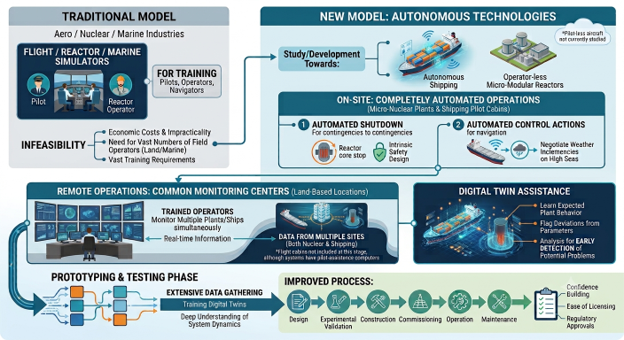
4.2 All these call for a need to build operational training/certification modules for manpower training. This would include specialized training through the use of full-scope simulators and associated digital twins. While the target value chain industrial complexes for such learnings and certifications could be different, there is a need to also sensitize the system integrators to get trained through its operation simulators & digital twins, so as to bring about a seamless integration between the manufacture, erection & commissioning, and operation teams, as a long-term strategy for managing the operation & maintenance of the types of plants (both land-based and sea-based).
5.0 Conclusion : Many different types of aero/nuclear/marine concepts/designs are presently underway internationally, and it could potentially be a game changer in the Indian context to have a strong industrial eco-system for critical infra industries, by raising the traditional supply chain to a high-end value chain, in both products & services. So, besides the growth of the technology and building the necessary value chains, through multiple MSMEs & start-ups, for meeting the safety requirements & quality levels demanded by aero/nuclear/marine, there is a significant need for the country to augment the existing technological capabilities and also the qualified manpower required. It is envisaged that there is a need to push the boundaries in modular academic & certification programs, to make our industrial eco-system world-class and competent to go up the value chain for meeting the nuclear/maritime/aero industry standards.
5.1 The table below offers a suggestive structure of up-skilling & knowledge-building for personnel (and thereby for MSMEs & start-ups), where the academic institutes, scientific labs and industrial training centers can all join hands to build such learning and training modules to help an industrial growth.
S.No. | Typical Approach towards building a Certification Program for Critical Infra Projects, with a specific focus on Aero/Nuclear, Marine Engg. Designs. In the present table only three essential disciplines have been considered — these of course are only suggestive and there could be multiple variations, w.r.t. type of industry, main product or service, size of the industry, skill-levels of employees, etc. | |||
— | Mechanical systems &, Materials | Process Systems & Equipment | Instrumentation Systems | |
0. |
| |||
1. | Use of Codes for Simulation for Systems & Structures | Design of Shell & Tube type, Plate & Shell Type Hex. | Design of Safety Inst. Sensors & Systems; Study of National/ International Standards. | |
2. | Fracture Mechanics, Stress Analysis, FEM & FDM Methods | Study of the Relevant International Codes & Standards in Hex Design | Special Considerations for Low & Ultra Low Signal Conditioning Circuits | |
3. | Study of Sections on Boiler & Pressure Vessel Codes | Design of PCHEX and Theory of Diffusion Bonding | Shielding, Grounding, Super-screened Cables | |
4. | Theory of Welding Technology | Study of Codes/ Standards/ Sections for Diffusion Bonding. (Conformance to any specific world standard) | Mounting of Electronic Systems, Bins/Racks, cabling/wiring stds., PCB Specs. For Safety | |
5. | Relevant Codes/ Standards on Weld Quality | Theory of Pump Design, Hydrodynamic & Hydrostatic Bearings, Codes/ Standards on Pump Designs. | EMI/EMC Aspects, Shielding of Racks/ Bins, Mounting of Low Signal Electronics in Proximity to HV Switching Devices | |
6. | Theory of Corrosion | Codes/Standards on Pump Materials | Pre-Amplifier Designs | |
7. | Inter-granular Stress Corrosion Cracking, Codes/Standards on Corrosion | Concepts of Coolant Thermal Hydraulics, Forced Circulation & Natural Circulation | Sensor Mounting & Associated Electronic Circuits | |
8. | Embrittlement concepts, NDTT | CFD Analysis Methods in Parameterization of Pump Designs & Use of Codes | Real Time OS, Task Schedulers, On-Line Diagnostics, Dual-Processor Hot Standby Designs, Use of PLCs | |
9. | Codes/Standards/ Guides on Embrittlement & NDTT. | Piping Design & Use of Pipe Supports | Codal Practices in Real-Time OS Designs. | |
10. |
Any other topic | Theory of Piping Design & Choice of Materials, Relevant Codes/ Standards/Guides; | Verification & Validation of Real Time OS | |
11. | . Any other topic |
Any other topic
| Integrated Tests & Conformance of Safety Criteria; Study of Simulators & Digital Twins | |
12. | ● Design basis events and load combinations. ● Design for adequate life(load) cycle and damage assessment.
| |||
The above table is only suggestive, but with the author’s experience in nuclear industry for nearly four decades, it is felt that these are the types of bench-marking which would help a vendor reach the technological understanding and meet the requirements to build an effective indigenous value chain for serving all critical infra industries.
Reference :
- Enabling MSMEs & Start-ups for Design & Manufacture for the Nuclear Industry, by Kallol Roy, Path to Decarbonization, The Energy Consortium, Special Issue II, June 2026, pp. 38-43.
- Courses offered by ASME, for Nuclear Industry, listed in the ASME web-site.
***********************