

Kishore Reddy Pagidi (2018)
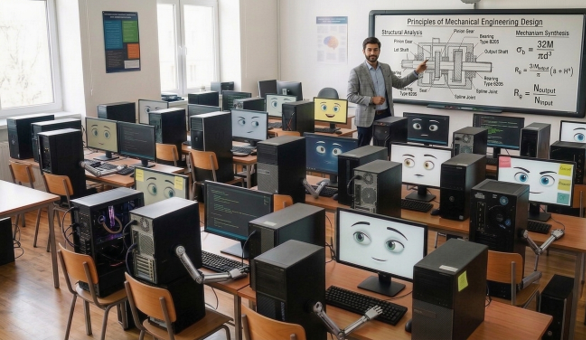
Illustarion: Gaurav (AI-assisted)
The first machine I ever truly understood, I understood at NIT Calicut.
It was an internal combustion engine in the Mechanical Engineering lab, and what stays with me is not the engine itself but the moment the diagram in the textbook and the metal on the bench became the same thing in my head. That feeling, of abstraction snapping into reality, is the thread that connects everything I have done since.
I graduated from NITC in 2018 with a B.Tech in Mechanical Engineering, and like many of us, I started where mechanical engineers start: on the factory floor. At Suzuki’s R&D division, I worked on ADAS sensor integration and optimized over a thousand robotic welding stations. It was unglamorous, precise work, and it taught me something no course could: how the physical world actually gets built, one fixture and one tolerance at a time.
But I kept noticing the gap between what engineers wanted to make and what the tools let them say. An engineer would describe a part in one sentence, then spend hours translating that sentence into clicks and commands. The machines were powerful, but the conversation with them was broken.
That question, how do you let machines understand intent, pulled me toward AI. I moved to Boston for a Master’s in Robotics at Northeastern University. There, I worked on the problem in its purest form: teaching robots to manipulate objects they had never seen before, from a single demonstration. That research was published at the Conference on Robot Learning (CoRL) in 2023, with co-authors from Google DeepMind and Microsoft Research, and has been cited by researchers around the world.
Along the way, at Mercedes-Benz R&D North America, I worked on autonomous driving and invented four UK-patented safety systems, including methods for vehicles to anticipate hazards they cannot yet see. Robots, cars, factories: different machines, same question. Can the machine understand what the human means?
Today I get to ask that question at scale. At Dassault Systèmes, I lead AI strategy for SOLIDWORKS, the 3D design software used by more than 8 million engineers worldwide. In 2025 we shipped the Generative Drawing Experience, a first-of-its-kind AI feature that lets mechanical engineers skip the blank sheet. I have started calling the larger shift “Vibe CADing”: you describe the part you want, and AI handles the how. I have presented this work at 3DEXPERIENCE World in Houston, to more than 5,000 engineers from over 40 countries.
When I stand on that stage, I am aware of a simple fact: every product in that room, every product anywhere, began as a design file made by an engineer. The phone in your pocket. The bridge you crossed today. The bus that took you from Calicut railway station to Kattangal on your first day. Someone designed each one, click by click. Giving those people better tools is, I believe, one of the highest-leverage things you can do with AI.
What did NITC give me? Three things, I think.
First, comfort with fundamentals. The mechanical engineering curriculum at Calicut is unforgiving about first principles, and first principles are exactly what survive when technologies change. I moved from thermodynamics to deep learning, but the habit of decomposing a problem to its physics never changed.
Second, the monsoon taught me patience. Anyone who has waited out a Kerala downpour under the Rajpath trees knows that some things cannot be rushed. Research is like that. Careers are like that.
Third, and most important: the people. The hostel-room arguments at 2 AM about everything and nothing, the lab partners who became lifelong friends, the professors who treated an undergraduate’s half-formed idea with full seriousness. NITC taught me that the quality of your thinking is set by the quality of the people you think with. I have since worked with researchers from DeepMind and engineers across three continents, and the bar for “good conversation” was set in Kattangal.
To the students reading this: the path from a mechanical engineering classroom in Kerala to defining AI products in Boston is not a straight line, and that is the point. Follow the question, not the title. Mine was always the same question, asked of engines, then robots, then cars, then design software: can we make machines that understand what we mean?
We are closer than ever. And some of the people who will close that gap are sitting in NITC lecture halls right now.
I would love to hear from fellow alumni working in AI, robotics, or engineering software. Find me on LinkedIn (linkedin.com/in/kishore005). The NITC network has given me more than I can repay, but I intend to try.
One Response
Really liked it ❤️, waiting for the next volume!